


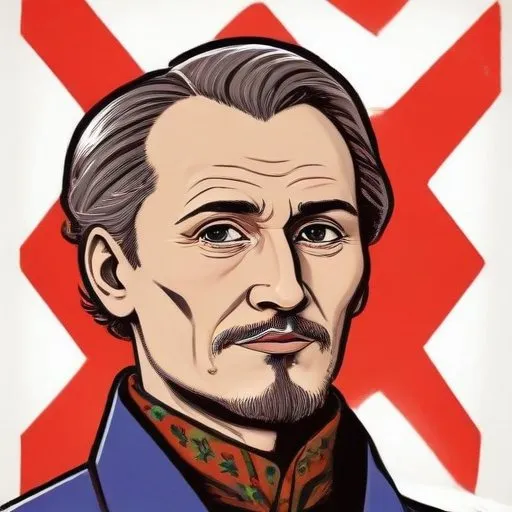
A Russian absurdist writer, known for his surreal and often humorous short stories, poetry, and plays that critique Soviet society. His unique style blends wit and darkness, leaving readers both entertained and unsettled.
Daniil Kharms, a renowned Russian poet, writer, and dramatist, is celebrated for his avant-garde and absurdist style, which revolutionized the literary landscape of the early Soviet era. Born in 1905, Kharms' innovative works continue to inspire and influence writers, artists, and thinkers to this day.
Kharms was born as Daniil Yuvachev in Saint Petersburg, Russian Empire, to a family with a strong revolutionary background. His father, Ivan Yuvachev, was a philosopher and a member of the revolutionary group "The People's Will." Kharms invented his pseudonym while attending Saint Petersburg School, where he learned English and German. The origin of his pseudonym remains shrouded in mystery, with theories ranging from the English words "harm" and "charm" to his fascination with Sherlock Holmes stories.
Expelled from the Leningrad Electrotechnicum in 1924, Kharms dedicated himself entirely to literature. He joined the circle of Aleksandr Tufanov, a sound poet, and follower of Velimir Khlebnikov's ideas of zaum or transsense poetry. This association led to his meeting with the young poet Alexander Vvedensky, with whom he formed a close friendship and collaborative partnership.
In 1927, Kharms became a member of the Association of Writers of Children's Literature, which marked the beginning of his prolific career in children's literature. From 1928 until 1941, he produced numerous successful children's works, solidifying his reputation as a master of the genre.
In 1928, Kharms co-founded the avant-garde collective OBERIU (Union of Real Art), along with Alexander Vvedensky and other like-minded artists. This collective sought to challenge traditional literary norms and push the boundaries of language, art, and thought. Kharms' involvement with OBERIU cemented his position as a visionary and innovator in the world of Russian literature.
Kharms' absurdist and avant-garde style has had a profound impact on modern literature and art. His work has inspired generations of writers, poets, and artists, including prominent figures like Andrei Bitov, Viktor Erofeev, and Dmitri Prigov.
Despite facing censorship and persecution during his lifetime, Kharms' work has continued to thrive, influencing contemporary literature, art, and culture. His legacy serves as a testament to the power of creative innovation and the importance of challenging societal norms.
Kharms' work is characterized by a deep sense of philosophical inquiry and exploration. His writing often blurred the lines between reality and fantasy, challenging readers to question the nature of existence and the human condition.
Through his work, Kharms probed the complexities of language, identity, and morality, often incorporating elements of absurdity and humor to subvert conventional expectations. His philosophical contributions continue to influence contemporary thought and artistic expression.
Kharms' life and work are deeply rooted in the tumultuous landscape of early Soviet Russia. Despite facing censorship, persecution, and eventually, tragic circumstances, Kharms persevered, leaving behind a profound legacy that continues to inspire and challenge artists and thinkers today.
In conclusion, Daniil Kharms' innovative and absurdist style has had a lasting impact on modern literature and art. His commitment to creative experimentation and his willingness to challenge societal norms have cemented his position as one of the most important and influential Russian writers of the 20th century.
Born in 1903
A Russian-Soviet poet and translator, known for his unique blend of avant-garde and traditional styles, which greatly influenced the development of Soviet poetry. His translations of French poetry also introduced many Russian readers to Western literature.
Born in 1906
A renowned Russian pianist and composer, known for blending classical music with dark humor and satire, creating iconic symphonies and film scores that still resonate today.
Born in 1880
A Russian literary giant, known for pioneering the avant-garde movement in literature, blending poetry and prose to create innovative, symbolic works that explored the human experience.
Born in 1893
A Russian avant-garde artist who revolutionized poetry and theater with his bold, futuristic style and passionate performances. He's most famous for his vibrant, propaganda-inspired posters and poems that captured the spirit of the Russian Revolution.
Born in 1885
A Russian avant-garde poet and playwright who pioneered Futurist movement, experimenting with language and form, and is considered a precursor to Dadaism and Surrealism.
Born in 1890
A Russian literary giant, renowned for his poetic and novelistic masterpieces, including the epic "Doctor Zhivago", which captured the essence of Soviet Russia. His works are a testament to the power of literature in shaping cultural identity.
Born in 1899
A Soviet writer and poet, known for his unique blend of realism and mysticism, exploring the human condition and the Russian Revolution in his works. His writing often blurred the lines between poetry and prose, creating a distinctive style.
