


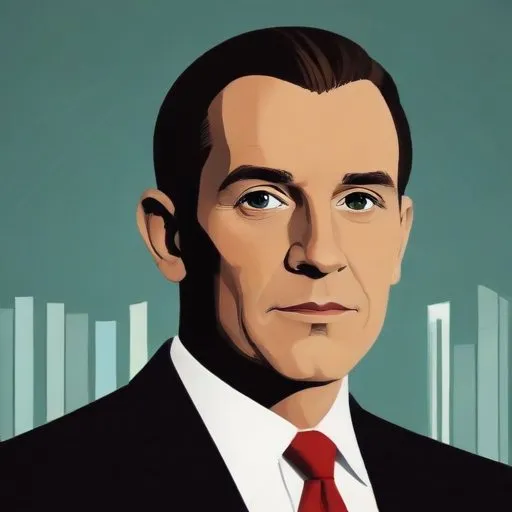
A prominent libertarian thinker and executive vice president of the Cato Institute, known for advocating individual liberty and limited government intervention.
David Boaz, a renowned American author, philosopher, and editor, is best known for his tireless advocacy of libertarianism and his influential role as the executive vice president of the Cato Institute, a leading libertarian think tank. His seminal work, Libertarianism: A Primer, published in 1997, is a seminal work that has shaped the understanding of libertarian ideas and principles.
Born on August 29, 1953, in Mayfield, Kentucky, Boaz came from a family of distinguished public servants. His father was a judge, and one of his uncles, Frank Stubblefield, served as a Democratic member of the U.S. House of Representatives. Boaz's early interests in politics and philosophy led him to study history at Vanderbilt University from 1971 to 1975, where he became involved with the Young Americans for Freedom and the College Republicans.
Boaz's career is marked by his commitment to libertarian ideas and his work with the Cato Institute, which he joined in the late 1970s. He was the editor of The Libertarian Reader and co-editor of the Cato Handbook for Congress 2003 and the Cato Handbook on Policy 2005. He frequently appeared on national television and radio shows, debating topics such as education choice, limited government, and drug legalization. His articles were published in prominent publications, including The Wall Street Journal, The Washington Post, and Los Angeles Times.
Boaz's philosophical foundation is rooted in classical liberalism, which emphasizes individual liberty, limited government, and free markets. He was skeptical of party politics and rejected populism, instead advocating for a non-interventionist foreign policy and individual rights. His ideas were shaped by his commitment to libertarian principles, which he believed were essential for promoting social justice and economic prosperity.
Boaz's work has had a significant impact on modern society, inspiring a new generation of libertarians and influencing public policy debates. His advocacy for education choice, for example, has contributed to the growth of school voucher programs and charter schools. His support for drug legalization has helped shift the national conversation on drug policy, with many states legalizing marijuana and other drugs.
Throughout his career, Boaz has been recognized for his contributions to libertarian thought and advocacy. He has received awards from the Libertarian Party and has been featured in various media outlets, including ABC's Politically Incorrect, CNN's Crossfire, and NPR's Talk of the Nation.
Boaz's vocal support for libertarian ideas has sometimes been met with criticism from both the left and right. His advocacy for drug legalization, for example, has been met with opposition from law enforcement groups and social conservatives. Despite these challenges, Boaz remained committed to his principles, earning him a reputation as a fearless and principled advocate for individual liberty.
"Liberty is not a means to an end, but an end in itself." - David Boaz
"The only way to make sense of the world is to understand that it is a complex, dynamic, and constantly changing system." - David Boaz
David Boaz's work has had a lasting impact on the development of libertarian thought and policy. His contributions to the Cato Institute, his writings, and his public advocacy have helped shape the national conversation on individual liberty, limited government, and free markets. As a tireless advocate for libertarian principles, Boaz leaves behind a legacy of intellectual curiosity, moral courage, and unwavering commitment to the ideals of liberty.
Boaz's work can be compared to that of other prominent libertarians, such as Milton Friedman and Ayn Rand. While sharing similar philosophical foundations, Boaz's approach was more pragmatic and policy-oriented, focusing on applying libertarian principles to real-world problems. His commitment to education choice, for example, reflects a practical approach to promoting individual liberty and social justice.
Boaz's personal relationships and anecdotes offer a glimpse into his personality and character. His colleagues and friends describe him as warm, witty, and intellectually curious, with a passion for ideas and a commitment to principle.
Boaz's ideas have influenced popular culture, with his advocacy for drug legalization and education choice echoing in films, television shows, and music. His commitment to individual liberty has inspired a new generation of artists, writers, and activists to explore the intersection of politics and culture.
Boaz has received numerous awards and honors for his contributions to libertarian thought and advocacy. These include the Libertarian Party's highest honor, the Thomas Paine Award, and the Cato Institute's Milton Friedman Prize for Advancing Liberty.
Boaz's educational contributions are significant, with his writings and advocacy shaping the understanding of libertarian principles and policy. His work has influenced a generation of students, scholars, and policymakers, inspiring a new era of research and debate on the role of government and individual liberty.
As we look to the future, Boaz's ideas and legacy will continue to shape the national conversation on individual liberty, limited government, and free markets. His commitment to education choice, drug legalization, and non-interventionist foreign policy will remain influential in shaping public policy debates.
Throughout his career, Boaz was involved in various charitable organizations and social causes, including education reform, animal welfare, and environmental protection. His commitment to social justice and individual liberty reflects a deep concern for human well-being and the common good.
Boaz's life and work offer a powerful inspiration to those committed to promoting individual liberty and social justice. His courage, moral integrity, and intellectual curiosity serve as a model for individuals seeking to make a positive impact on the world.
91 Years Old
A physician-turned-politician who championed libertarian ideals and ran for US president multiple times, known for his advocacy of limited government and individual freedoms.
73 Years Old
The 29th Governor of New Mexico, a Libertarian presidential candidate, and entrepreneur who advocates for limited government and individual freedom. Known for his unconventional style and views on drug legalization.
Born in 1912
A Nobel Prize-winning economist who championed free market capitalism and limited government intervention, known for his advocacy of laissez-faire economics and influential writings on monetary policy.
Born in 1905
Russian-born American novelist and philosopher who wrote influential novels like "The Fountainhead" and "Atlas Shrugged", promoting individualism and capitalism.
87 Years Old
A renowned philosopher who challenged traditional notions of justice, morality, and the role of government, known for his influential book "Anarchy, State, and Utopia".
Born in 1899
Austrian economist and philosopher who championed free market capitalism and limited government intervention, warning of the dangers of socialism and totalitarianism. His work influenced economic policy and shaped modern libertarian thought.
Born in 1881
A pioneer of Austrian economics, he developed the concept of praxeology, which focuses on human action and its consequences, and is known for his critiques of socialism and central planning.
Born in 1926
A prominent figure in the Austrian School of economics, known for his libertarian and anarchist views, and his work on the history of economic thought.
