


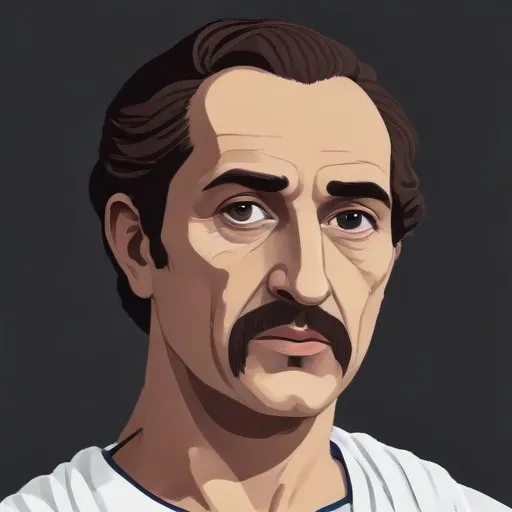
A Greek poet and playwright known for his avant-garde and experimental works that blend poetry, drama, and performance art, pushing the boundaries of language and narrative. His writing often explores themes of identity, history, and the human condition.
Dimitris Lyacos is a contemporary Greek writer renowned for his genre-defying Poena Damni trilogy, a sweeping narrative that blends literary tradition with elements of ritual, religion, philosophy, and anthropology.
This avant-garde masterpiece, which took over thirty years to complete, is a testament to Lyacos' innovative spirit and his ability to push the boundaries of storytelling.
Born on October 19, 1966, in Athens, Greece, Lyacos studied law in his hometown before embarking on a literary journey that would take him to the forefront of contemporary Greek literature.
The Poena Damni trilogy is a complex, fractured narrative that defies categorization. The three books – Z213: Exit, With the People from the Bridge, and The First Death – are a testament to Lyacos' mastery of genre-bending storytelling.
Through his work, Lyacos explores themes of redemption, physical suffering, mental illness, and the human condition, weaving together a rich tapestry of literary traditions, philosophical concepts, and anthropological insights.
Lyacos' writing style is characterized by its fragmentation, non-linearity, and experimentation with form. His use of prose, drama, and poetry creates a unique narrative experience that challenges readers to engage with the text on multiple levels.
His work has been likened to that of Gabriel García Márquez and Thomas Pynchon, and has been recognized as an exponent of the postmodern sublime and a notable anti-utopian work of the 21st century.
Lyaocs is widely regarded as the most prominent contemporary Greek author and a strong candidate for the Nobel Prize in Literature.
He has been featured in Who's Who, a database of the most prominent individuals across all fields of human activity, a testament to his impact on literature and his international recognition.
Dimitris Lyacos' innovative approach to storytelling has left an indelible mark on contemporary literature.
His work has inspired a new generation of writers and continues to challenge readers and scholars alike, ensuring his place as one of the most important literary figures of the 21st century.
As his work continues to gain international recognition, Lyacos remains a testament to the power of literature to push boundaries, challenge conventions, and inspire new ways of thinking.
Born in 1909
A celebrated Greek poet and playwright, known for his powerful and evocative works that often explored themes of love, politics, and the human condition. His poetry is characterized by its lyricism and accessibility.
Born in 1900
A Greek poet and diplomat who won the Nobel Prize in Literature in 1963 for his lyrical and symbolic poetry that explored Greek identity and culture. His work is known for its evocative and introspective style.
Born in 1911
A Greek poet and critic, renowned for his lyrical and evocative works that explored the human experience, mythology, and the Greek identity. His poetry is celebrated for its musicality and depth.
Born in 1863
A renowned poet and journalist who crafted evocative, historically-inspired verses that probed the human condition, exploring themes of love, identity, and mortality. His unique style blended ancient and modern elements, earning him a devoted following.
Born in 1884
A leading figure in the Greek literary revival of the 20th century, known for blending folk traditions with modernist experimentation in his poetry and plays. His work explores themes of identity, mythology, and the human condition.
Born in 1859
A leading figure of the Greek literary generation of the 1880s, he wrote influential poetry and plays that explored themes of Greek identity and national revival. His works are considered cornerstones of modern Greek literature.
