


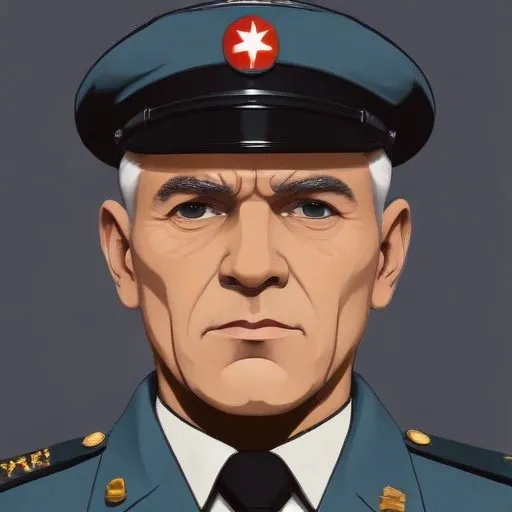
Notorious commander of a Croatian concentration camp during World War II, responsible for heinous war crimes and atrocities. His brutal regime was marked by torture, murder, and forced labor.
Dinko Šakić, a Croatian Ustase official, is infamously known for commanding the Jasenovac concentration camp during World War II, where an estimated 2,000 people lost their lives under his brutal regime. Šakić's leadership at Jasenovac, from April to November 1944, marked a period of unparalleled cruelty and terror, earning him a reputation as one of the most ruthless concentration camp commanders in history.
Born on September 8, 1921, in Studenci, near Imotski, in the Kingdom of Serbs, Croats, and Slovenes, Šakić joined the fascist Ustase at a young age. His fanatic support for Ustase leader Ante Pavelić and his marriage to Nada Luburi, the half-sister of concentration camp commander Vjekoslav Maks Luburi, in 1943, paved the way for his rapid rise to power within the Ustase ranks.
Šakić's time as commander of Jasenovac concentration camp was marked by unimaginable brutality and violence. Under his command, thousands of innocent lives were lost, and the camp became a symbol of terror and oppression. Šakić's zeal for the Ustase ideology and his unwavering loyalty to Pavelić drove him to commit atrocities that would haunt him for the rest of his life.
In 1945, as the Axis powers began to collapse, Šakić and his wife fled the Independent State of Croatia, eventually finding refuge in Argentina in 1947. In his new life, Šakić started a textile business and became an active member of the local Croat community, even befriending Paraguayan dictator Alfredo Stroessner.
In 1990, Šakić granted an interview to the Feral Tribune, which published his picture, sparking outrage among those who had suffered under his regime. Four years later, he attended a reception in Buenos Aires, where he met Croatian President Franjo Tuđman, and was subsequently interviewed by the Croatian publication Magazin. In the interview, Šakić callously stated that he would do it all again, claiming he slept like a baby, unperturbed by the atrocities he had committed.
Šakić's later years were marked by a mix of relative obscurity and public appearances. In 1998, he was interviewed by Argentine national television, where he showed no remorse for his actions. Šakić's legacy is one of brutality, violence, and oppression, a stark reminder of the dangers of extremist ideologies and the devastating consequences of hate and intolerance.
