


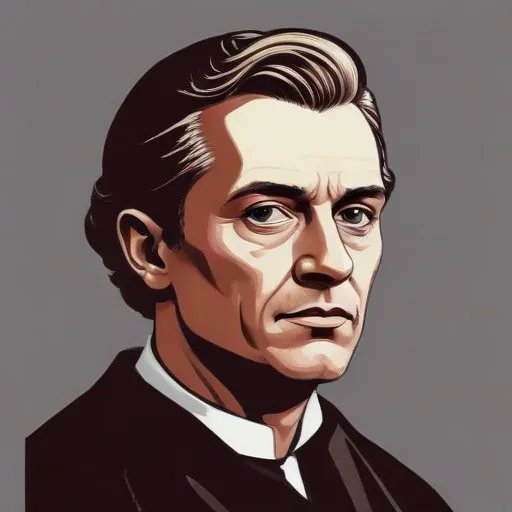
A 16th-century Dutch scholar and writer who advocated for religious tolerance and individual freedom, producing influential works on ethics, politics, and literature.
Dirck Volckertszoon Coornhert, also known as Theodore Cornhert, was a Dutch polymath who made his mark on the world as a writer, philosopher, translator, politician, theologian, and artist. He is often referred to as the Father of Dutch Renaissance scholarship, a testament to his profound impact on the cultural and intellectual landscape of the Netherlands during the 16th century.
Born in 1522, Coornhert was the youngest son of Volckert Coornhert, a cloth merchant in Amsterdam. During his childhood, he spent time in Spain and Portugal, where he was exposed to the rich cultural heritage of the Mediterranean. This experience would later influence his work and worldview.
Upon his return to the Netherlands, Coornhert was disinherited by his father's will in 1539, following his marriage to Cornelia Neeltje Simons, a gentlewoman from Haarlem. This turnaround in his fortunes led him to seek out new opportunities, which eventually brought him into contact with the famous artist Maarten van Heemskerck.
Under the tutelage of Heemskerck, Coornhert honed his skills as an engraver on copper, producing works that gained popularity in the Netherlands. His artistic talents were soon complemented by his linguistic abilities, as he learned Latin in 1552 and began publishing Dutch translations of classical works by Cicero, Seneca, and Boethius.
Coornhert's magnum opus, a translation of the first twelve books of Homer's Odyssey, was published in 1562 and is considered one of the first major works of Dutch Renaissance poetry. This achievement cemented his reputation as a master of language and literature.
Coornhert's love for his country and its people drove him to become actively involved in the struggle for independence from Spanish rule. He played a crucial role in drafting the manifesto of William the Silent, Prince of Orange, in 1566, a document that galvanized the Dutch people to fight for their freedom.
In 1568, Coornhert was imprisoned at The Hague, but he managed to escape to Cleves, where he continued to work as an artist. Later, in 1572, he was recalled to serve as secretary of state in the Dutch Republic, a position that allowed him to contribute to the country's governance and development.
Dirck Coornhert's multifaceted career and contributions have left an indelible mark on Dutch history and culture. He is remembered as a champion of knowledge, art, and freedom, and his works continue to inspire scholars and artists to this day.
Through his writings, translations, and artistic creations, Coornhert helped shape the Dutch Renaissance, fostering a cultural awakening that resonated across Europe. His legacy serves as a testament to the power of human creativity, perseverance, and dedication to the pursuit of knowledge and wisdom.
Born in 1466
A 16th-century Renaissance humanist who advocated for education, tolerance, and critical thinking, and is famous for his witty and insightful writings, particularly "In Praise of Folly".
Born in 1583
A 17th-century philosopher and jurist who laid the foundations for modern international law, particularly the concept of "just war" and the laws of the sea.
Born in 1547
A renowned Renaissance scholar who revived interest in Stoic philosophy and wrote influential works on ancient Roman history and culture.
Born in 1581
A 16th-century Dutch historian and poet who wrote influential works on Dutch history and literature, including the first comprehensive history of the Netherlands.
Born in 1587
A 17th-century master of Dutch literature, penning influential plays and poems that shaped the country's cultural identity. His works remain a testament to his innovative storytelling and poetic flair.
