


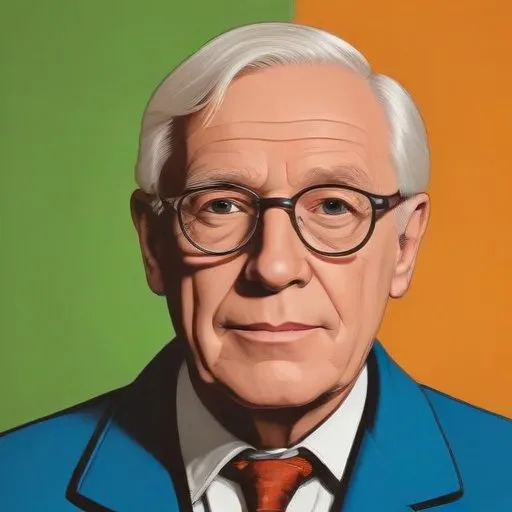
Developed innovative methods for synthesizing and characterizing complex organic molecules, earning a Nobel Prize in Chemistry in 1987. His work revolutionized the field of organic chemistry and led to numerous breakthroughs in medicine and materials science.
Donald J. Cram, an American chemist, is renowned for his groundbreaking work in the field of host-guest chemistry, earning him the 1987 Nobel Prize in Chemistry along with Jean-Marie Lehn and Charles J. Pedersen. His research focused on the development and use of molecules with structure-specific interactions of high selectivity, paving the way for significant advancements in fields such as medicine, materials science, and biotechnology.
Born on April 22, 1919, in Chester, Vermont, Cram's life was marked by early hardships, including the loss of his father at the age of four. Despite these challenges, he demonstrated a strong work ethic, taking on various jobs such as picking fruit, tossing newspapers, and painting houses, while also bartering for piano lessons.
Cram attended Winwood High School in Long Island, New York, and later earned a national honorary scholarship to Rollins College in Winter Park, Florida, where he worked as an assistant in the chemistry department. He graduated in 1941 with a BS in chemistry and went on to earn his MS in organic chemistry from the University of Nebraska-Lincoln in 1942, under the guidance of Norman O. Cromwell. Cram's PhD in organic chemistry from Harvard University in 1947 was supervised by the esteemed Louis Fieser.
From 1942 to 1945, Cram worked at Merck & Co. laboratories, conducting penicillin research under the mentorship of Max Tishler. Following his postdoctoral work, he embarked on a distinguished academic career, holding positions at the University of California, Los Angeles (UCLA) and later at the University of Southern California.
Cram's research focused on the design and synthesis of complex molecules with specific binding properties, which led to the development of host-guest chemistry. His work has far-reaching implications in areas such as molecular recognition, supramolecular chemistry, and catalysis.
Donald J. Cram's pioneering work in host-guest chemistry has had a profound impact on the development of new materials, medicines, and diagnostic tools. His research has inspired generations of scientists, and his legacy continues to shape the field of chemistry.
Cram's work has also led to the development of new technologies, including molecular sensors, catalysts, and drug delivery systems. His influence extends beyond the scientific community, as his discoveries have improved human lives and continue to shape the course of modern society.
Cram was known for his enthusiastic approach to science, often stating, "The most important thing in science is to be enthusiastic." He was also an accomplished pianist and enjoyed playing the organ in his spare time.
Throughout his life, Cram was driven by a passion for discovery and a dedication to mentoring the next generation of scientists. His remarkable journey serves as an inspiration to aspiring chemists and researchers worldwide.
Born in 1901
Pioneering chemist and peace activist who won two unshared Nobel Prizes, one for chemistry and one for peace, for his groundbreaking work on the nature of the chemical bond and his tireless efforts to promote nuclear disarmament.
Born in 1917
Pioneering organic chemist who synthesized complex natural products and developed new methods, earning a Nobel Prize in Chemistry. His work revolutionized the field of organic chemistry.
98 Years Old
Developed innovative synthetic methods, transforming organic chemistry and enabling the creation of complex molecules with precise structures.
Born in 1918
Organic chemist and Nobel laureate who developed a new way to synthesize complex molecules, revolutionizing the field of chemistry. His work led to the creation of new medicines and materials.
Born in 1897
A Norwegian chemist and academic who pioneered the study of molecular structure, particularly the three-dimensional shape of molecules, and was awarded the Nobel Prize in Chemistry in 1969.
Born in 1893
A pioneering scientist who discovered deuterium, a heavy isotope of hydrogen, and later contributed to the discovery of many other elements, revolutionizing our understanding of the universe.
Born in 1912
A renowned chemist and academic who discovered and isolated ten transuranic elements, including plutonium, and was a leading figure in the development of nuclear energy. His work had a profound impact on our understanding of the periodic table and the properties of atomic nuclei.
