


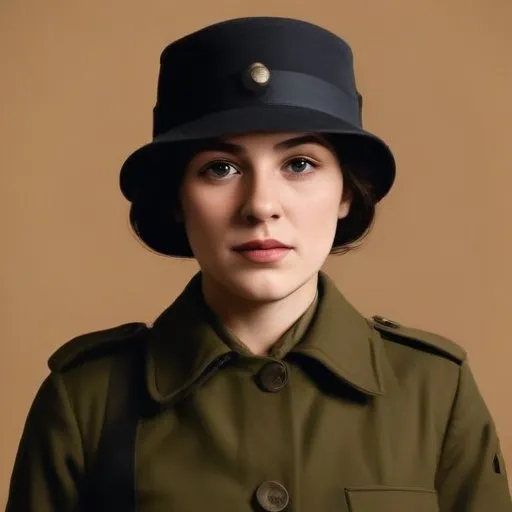
A brave and daring journalist who disguised herself as a man to fight on the front lines of World War I, uncovering the harsh realities of war. Her courageous feat paved the way for future female war correspondents.
Dorothy Lawrence, a courageous and daring English journalist, made headlines in 1915 by disguising herself as a male soldier to report from the front lines of World War I. This trailblazing feat of journalism earned her a place in history as one of the first female war correspondents.
Lawrence's birth on October 4, 1896, in Hendon, Middlesex, was shrouded in mystery. Her parentage remains unclear, with some sources suggesting she was illegitimate and adopted by a guardian of the Church of England. Despite the unclear circumstances, Lawrence's determination and spirit would soon take center stage.
In 1915, Lawrence traveled to France, where she obtained a military uniform and a false identity. Posing as a male soldier, she managed to reach the front lines in Albert, Somme, with the help of a sympathetic soldier. For ten days, she witnessed the harsh realities of trench warfare, but her health began to deteriorate. Fearing that if she required medical attention, her true identity would be discovered, putting those who had assisted her in danger, Lawrence revealed her sex.
Lawrence's bravery was met with suspicion and distrust. Arrested and interrogated, she was accused of being a spy or a prostitute. Authorities forced her to return home under a strict agreement not to write about her experiences. This attempted to silence her, but Lawrence's story would eventually see the light of day.
After the war, Lawrence published a memoir, but it was heavily censored and unsuccessful. Her health continued to decline, and she was eventually committed to a mental institution, where she spent the remaining 40 years of her life. It wasn't until 2003, nearly four decades after her passing, that Lawrence's remarkable story was rediscovered.
In 2003, Lawrence's memoir was reprinted, and the Imperial War Museum featured her experiences in an exhibition on women at war. Since 2015, her story has inspired several plays and films, cementing her legacy as a pioneering female journalist.
Lawrence's courage and determination continue to inspire, leaving behind a legacy that encourages future generations to push boundaries and challenge conventions.
"I wanted to see the reality of war, not just the official version."
Lawrence's remarkable story serves as a testament to the power of courage, perseverance, and the pursuit of truth, making her an enduring symbol of journalistic excellence and female empowerment.
Born in 1899
A legendary writer who crafted sparse, powerful prose, capturing the human experience in novels like "The Old Man and the Sea" and "A Farewell to Arms".
Born in 1908
A pioneering war correspondent and novelist who reported on conflicts from the Spanish Civil War to Vietnam, known for her fearless and insightful reporting.
Born in 1871
Prolific writer of historical novels and adventure stories, also a talented landscape painter.
Born in 1889
The dictator of Nazi Germany, responsible for the genocide of six million Jews and millions of other people during World War II, and infamous for his extreme nationalist and anti-Semitic ideology.
Born in 1878
The Soviet Union's ruthless leader who ruled with an iron fist, implementing policies that led to widespread famine and purges, while also playing a crucial role in defeating Nazi Germany in World War II.
Born in 1903
A renowned writer of dystopian classics, such as "1984" and "Animal Farm", who warned of totalitarianism's dangers through allegorical fiction.
Born in 1903
A renowned English writer, known for his witty satires and novels of manners, particularly "Brideshead Revisited", which explores the British aristocracy's decline.
Born in 1913
A pioneering war photographer and journalist, capturing iconic images of conflict and human struggle, particularly during World War II and the Spanish Civil War.
