


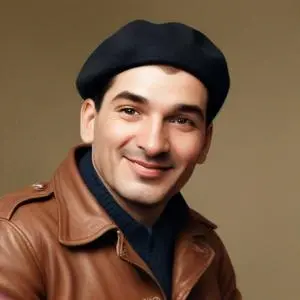
A pioneering war photographer and journalist, capturing iconic images of conflict and human struggle, particularly during World War II and the Spanish Civil War.
Robert Capa, born Endre Ern Friedmann, is widely regarded as the greatest combat and adventure photographer in history. His fearless approach to capturing the brutality of war has left an indelible mark on the world of photojournalism.
Capa was born on October 22, 1913, in Budapest, Austria-Hungary, to a Jewish family. At the age of 18, he fled political repression in Hungary and moved to Berlin, where he enrolled in college. However, the rise of Hitler led him to flee once again, this time to Paris, where he met his professional partner, Gerda Taro.
Capa and Taro began to publish their work separately, gaining recognition for their unique and daring approach to photography. Capa's photos were soon published in major magazines and newspapers, cementing his reputation as a fearless war photographer.
Capa covered five wars during his career, including the Spanish Civil War, the Second Sino-Japanese War, World War II, the 1948 Arab-Israeli War, and the First Indochina War. His most iconic moment came during World War II, when he became the only civilian photographer to land on Omaha Beach on D-Day.
In 1947, Capa co-founded Magnum Photos in Paris, the first cooperative agency for worldwide freelance photographers. This organization has since become a bastion of photojournalism, and a testament to Capa's vision and legacy.
Capa received the Medal of Freedom from U.S. general Dwight D. Eisenhower in 1947, in recognition of his work recording World War II in pictures.
Capa's friends and colleagues included some of the most iconic figures of the 20th century, including Ernest Hemingway, Irwin Shaw, John Steinbeck, and director John Huston. His deep friendship with David Seymour, also known as Chim, was captured in Martha Gellhorn's novella, Two by Two.
On May 25, 1954, Capa stepped on a landmine in Vietnam, ending his life at the age of 40. However, his legacy continues to inspire generations of photographers and journalists. Hungary has issued a stamp and a gold coin in his honor, cementing his place as one of the most influential photographers in history.
Despite his untimely death, Robert Capa's legacy continues to inspire and influence the world of photojournalism. His fearless approach to capturing the truth, even in the face of danger, has left an indelible mark on history.
Born in 1908
A pioneer of street photography, capturing life's fleeting moments in elegant, geometric compositions that defined the genre. Known for coining the term "the decisive moment."
Born in 1910
A pioneering female war photographer who captured the Spanish Civil War's brutal reality through her lens, leaving a lasting impact on the genre.
Born in 1911
A Polish-born photographer who captured iconic images of World War II, including the liberation of concentration camps, and was a pioneer of photojournalism.
Born in 1921
A pioneering photojournalist capturing intimate, vibrant moments of humanity, often using bold colors and abstract compositions to convey emotion and tell stories.
98 Years Old
A renowned photographer and director, capturing iconic, humorous, and poignant moments in history, from politics to everyday life, with a unique, humanizing perspective.
46 Years Old
Australian rugby league halfback who played for the St. George Dragons and represented New South Wales and Australia in the 1950s and 1960s. He was a prolific try-scorer and won three premierships with the Dragons.
