


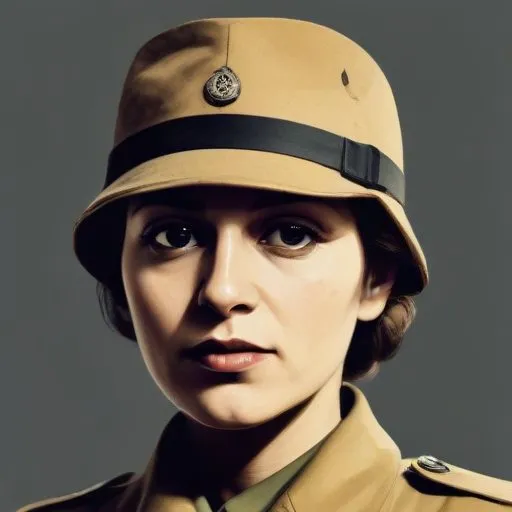
A pioneering female war photographer who captured the Spanish Civil War's brutal reality through her lens, leaving a lasting impact on the genre.
Gerda Taro was a trailblazing German war photographer who made history as the first female photojournalist to die while covering the frontline in a war. Her fearless approach to capturing the horrors of war and her unwavering commitment to telling the truth through her lens have cemented her legacy as one of the most influential war photographers of all time.
Born Gerta Pohorylle on August 1, 1910, in Stuttgart, Germany, to a middle-class Jewish family, Taro's early life was marked by a sense of adventure and a desire for social justice. After studying at Queen Charlotte High School and spending a year at a Lausanne boarding school, she attended a business college. However, her life took a dramatic turn in 1929 when her family moved to Leipzig, just prior to the rise of Nazi Germany.
Taro's opposition to the Nazi Party led to her arrest and detention in 1933 for distributing anti-Nazi propaganda. Her entire family was eventually forced to leave Germany, with Taro, then 23, heading to Paris, while her parents attempted to reach mandatory Palestine. Her brothers went to England, and she would never see her family again.
In Paris, Taro met Endre Friedmann, a Hungarian photographer who would later become known as Robert Capa. Together, they shared an alias, "Robert Capa," to mitigate the increasing political intolerance in Europe and to attract the lucrative American market. This partnership would become one of the most iconic and influential in the history of photography.
Taro's career was brief but explosive, with her work in the Spanish Civil War setting a new standard for war photography. Her photographs, often credited to Robert Capa, captured the horrors of war with a sense of intimacy and immediacy that was unprecedented at the time.
Taro's work helped establish the genre of modern war photography, and her influence can be seen in generations of photographers who followed in her footsteps. Her fearlessness and commitment to telling the truth through her lens have inspired countless individuals to pursue careers in photojournalism.
Taro's work was driven by a strong sense of social justice and a commitment to telling the truth, even in the face of overwhelming danger. Her photographs reflect a deep humanity and empathy, and her legacy continues to inspire individuals to use their talents to make a positive impact on the world.
Taro's work has had a profound impact on modern society, inspiring generations of photographers, journalists, and human rights activists. Her fearless approach to war photography has raised awareness about the human cost of conflict and has helped to shape public opinion on issues of social justice.
"The truth is the most powerful thing in the world, and it will always come out."
Taro's life and work are a testament to the power of courage and conviction in the face of overwhelming adversity. Her legacy continues to inspire individuals to use their talents to make a positive impact on the world, and her influence can be seen in generations of photographers, journalists, and human rights activists.
Born in 1913
A pioneering war photographer and journalist, capturing iconic images of conflict and human struggle, particularly during World War II and the Spanish Civil War.
Born in 1908
A pioneer of street photography, capturing life's fleeting moments in elegant, geometric compositions that defined the genre. Known for coining the term "the decisive moment."
Born in 1904
Pioneering photographer and journalist who captured iconic images of the Great Depression and World War II, and was the first woman to fly on a combat mission.
Born in 1921
A pioneering photojournalist capturing intimate, vibrant moments of humanity, often using bold colors and abstract compositions to convey emotion and tell stories.
Born in 1907
A pioneering model-turned-photographer who captured intimate portraits of WWII soldiers and later became a renowned war correspondent, known for her striking images and fearless approach.
Born in 1911
A Polish-born photographer who captured iconic images of World War II, including the liberation of concentration camps, and was a pioneer of photojournalism.
