


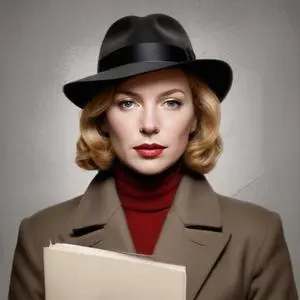
A pioneering war correspondent and novelist who reported on conflicts from the Spanish Civil War to Vietnam, known for her fearless and insightful reporting.
Martha Gellhorn, one of the most renowned war correspondents of the 20th century, reported on virtually every major world conflict during her 60-year career, earning her a reputation as a fearless and passionate journalist. From the Spanish Civil War to the Vietnam War, Gellhorn's unwavering dedication to telling the truth brought her to the forefront of journalism, making her a legend in her own right.
Born on November 8, 1908, in St. Louis, Missouri, Martha Gellhorn was the daughter of Edna Fischel Gellhorn, a suffragist, and George Gellhorn, a German-born gynecologist. Her family's strong liberal values and commitment to social justice instilled in her a sense of responsibility to use her voice to make a difference. Gellhorn attended John Burroughs School in St. Louis and later enrolled in Bryn Mawr College, but left without graduating to pursue a career in journalism.
Gellhorn's early years as a journalist were marked by a determination to break into the male-dominated world of foreign correspondence. In 1930, she moved to France, where she worked at the United Press bureau in Paris, honing her skills and building her reputation as a fearless and dedicated journalist. Her big break came in 1937, when she covered the Spanish Civil War, reporting on the atrocities committed by both sides and earning her a reputation as a bold and uncompromising journalist.
Gellhorn's remarkable career was marked by numerous awards and honors, including the O. Henry Award for her short story "The Wine of Astonishment" and the National Book Award nomination for her novel "The Face of War". In 1999, the Martha Gellhorn Prize for Journalism was established in her honor, recognizing outstanding journalism that exposes human rights abuses and social injustice.
Gellhorn's personal life was marked by a tumultuous marriage to American novelist Ernest Hemingway, whom she divorced in 1945. Her later years were marked by struggles with depression and ill health, and she died on February 15, 1998, at the age of 89.
Martha Gellhorn's legacy is that of a trailblazing journalist who paved the way for future generations of women in journalism. Her unwavering commitment to telling the truth, no matter the cost, has inspired countless journalists and writers around the world. Her work continues to be celebrated for its passion, courage, and unwavering dedication to exposing human rights abuses and social injustice.
Gellhorn's work must be seen within the context of a tumultuous 20th century, marked by two world wars, the Cold War, and numerous global conflicts. Her fearless reporting and commitment to social justice set her apart from her contemporaries, and her work remains a testament to the power of journalism to shape public opinion and bring about change.
Born in 1899
A legendary writer who crafted sparse, powerful prose, capturing the human experience in novels like "The Old Man and the Sea" and "A Farewell to Arms".
Born in 1866
A visionary writer who pioneered the science fiction genre, crafting timeless classics like "The Time Machine" and "War of the Worlds" that continue to inspire and captivate audiences today.
Born in 1896
A pioneering writer of the Lost Generation, known for experimental novels that capture the spirit of early 20th-century America, blending fiction and journalism.
Born in 1893
A witty and insightful writer who crafted poetry, short stories, and critiques that continue to delight readers with their clever wordplay and sharp observations.
Born in 1913
A pioneering war photographer and journalist, capturing iconic images of conflict and human struggle, particularly during World War II and the Spanish Civil War.
Born in 1905
Pioneering playwright and screenwriter who crafted intricate, socially conscious dramas that probed the human condition, often focusing on moral dilemmas and personal relationships.
Born in 1884
A humanitarian and politician who championed human rights, women's empowerment, and social justice, leaving a lasting impact on American politics and international relations.
Born in 1892
A pioneering journalist and author, known for her vivid and insightful reporting on European culture and politics, particularly her Paris Letter column in The New Yorker.
