


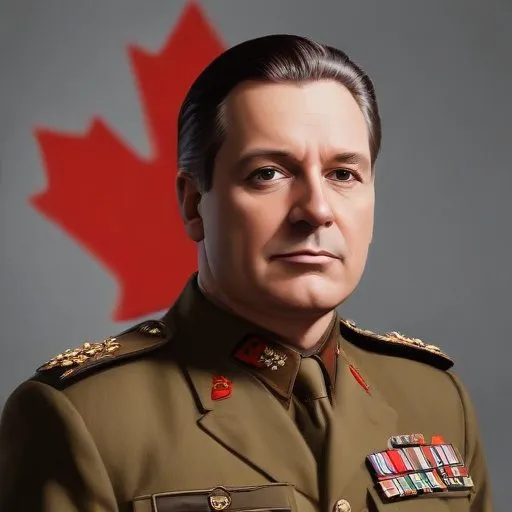
A Canadian colonel and politician who served as Minister of National Defence, known for his military service and leadership during World War II. He played a significant role in shaping Canada's military policy and defence strategy.
Douglas Scott Harkness was a Canadian politician and war hero, best known for his bravery during World War II and his subsequent outspoken stance against nuclear warheads in Canada. As a Member of Parliament, Harkness served in various cabinet positions, including Minister of National Defence, before resigning in protest of Prime Minister John Diefenbaker's policies.
Born on March 29, 1903, in Toronto, Ontario, Harkness later moved to Calgary, Alberta in 1929. He graduated from the University of Alberta and went on to farm and teach school in the vicinity of Red Deer. Before entering politics, Harkness taught at Crescent Heights High School until 1939.
Harkness's military service during World War II was a defining period in his life. He enlisted in 1940 and served in the European theater of war, including postings in Great Britain, Sicily, Italy, and Northwest Europe. In 1943, Harkness was awarded the George Medal for his bravery during the war. Specifically, he was recognized for his role in organizing the evacuation of a troopship after it was torpedoed while traveling from Sicily to England.
After returning from the war, Harkness entered politics and was elected to the House of Commons of Canada in 1945, representing the constituency of Calgary East. He served in various cabinet positions under Prime Minister John Diefenbaker, including Minister of Northern Affairs, Minister of National Revenue, and Minister of Agriculture.
Harkness's time in politics was marked by controversy, particularly when he resigned as Minister of National Defence in 1963. He opposed Diefenbaker's stance on stationing American nuclear warheads in Canada, leading to a split in the cabinet and contributing to the government's defeat in the 1963 federal election. Harkness continued to serve as a Member of Parliament until 1972.
In recognition of his contributions to Canada, Harkness was made an Officer of the Order of Canada in 1978. His legacy as a war hero and outspoken politician continues to inspire Canadians today.
Harkness lived in Calgary until his death on May 2, 1999. Despite his passing, his courage and conviction remain an important part of Canadian history.
Born in 1897
A Canadian leader who served as Prime Minister and won the Nobel Peace Prize for resolving the Suez Canal Crisis, known for his diplomatic efforts and peacekeeping initiatives.
Born in 1895
The 13th Prime Minister of Canada, a champion of individual rights and freedoms, introduced the Canadian Bill of Rights, a precursor to the Charter of Rights and Freedoms. He's also known for his anti-apartheid stance and leadership during the Suez Crisis.
Born in 1882
The 12th Prime Minister of Canada, a strong leader who played a crucial role in shaping the country's post-war economy and foreign policy, and is credited with establishing universal hospital insurance and old-age pensions.
Born in 1870
The 11th Prime Minister of Canada, a lawyer-turned-politician who led the country through the Great Depression, implementing policies to alleviate economic suffering. He's known for his efforts to establish a Canadian welfare state.
Born in 1874
The tenth Prime Minister of Canada, serving for a record 22 years, is most known for leading the country through significant periods of economic and social change, including the Great Depression and World War II.
Born in 1903
A Canadian lawyer and politician who served as a Cabinet minister and Senator, known for his influential role in shaping the country's social and economic policies. He was a key figure in the development of Canada's universal healthcare system.
92 Years Old
The 20th Prime Minister of Canada, serving from 1993 to 2003, known for his leadership during the Quebec sovereignty movement and his role in shaping Canada's national unity. He implemented policies like the Clarity Act and the National Child Benefit.
87 Years Old
The 18th Prime Minister of Canada, a skilled lawyer and politician, led the country from 1984 to 1993, known for negotiating the Canada-US Free Trade Agreement and introducing the Goods and Services Tax.
