


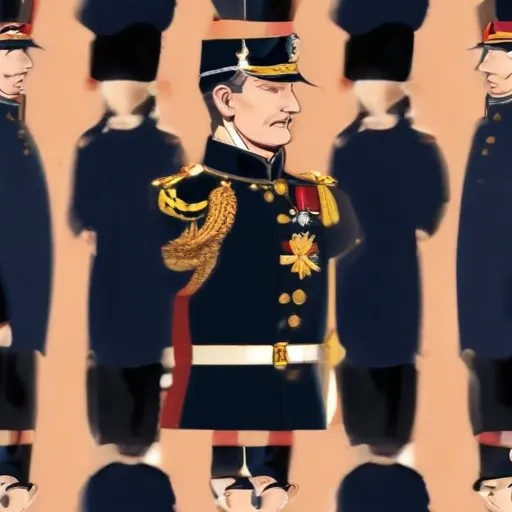
A skilled military leader who played a key role in the Seven Years' War, earning recognition for his tactical genius and bravery on the battlefield. He's also known for his patronage of the Enlightenment thinker Immanuel Kant.
Duke Ferdinand of Brunswick-Wolfenbüttel is renowned for his exceptional military prowess, leading an Anglo-German army to victory against French forces in western Germany during the Seven Years War (1756-1763). As a distinguished field marshal, he successfully repelled French attempts to occupy Hanover, earning him a prominent place in the annals of military history.
Born on January 12, 1721, in Wolfenbüttel, Germany, Ferdinand was the fourth son of Ferdinand Albert II, Duke of Brunswick-Lüneburg. He began his military career in 1740 as a colonel in the Prussian army, where he fought in the battles of Mollwitz and Chotusitz.
After the death of Margrave Wilhelm of Brandenburg-Schwedt at the Battle of Prague in 1744, Ferdinand took command of Frederick the Great's Leibgarde battalion. His outstanding performance at the Battle of Soor in 1745, where he led a daring assault on a steep hill defended by his older brother, Duke Louis Ernest of Brunswick-Lüneburg, solidified his reputation as a skilled military leader.
Ferdinand's involvement in the Seven Years War marked the pinnacle of his military career. In 1756, he led part of the invasion of Saxony and Bohemia, participating in the Battle of Rossbach. He subsequently became commander of the allied Hanoverian Army, working closely with British forces to counter French aggression in western Germany.
Ferdinand's strategic brilliance was instrumental in the Allied victory at the Battle of Minden in 1759. His innovative tactics, which included the use of light infantry and cavalry, allowed his forces to outmaneuver and defeat the French army, despite being outnumbered.
As a testament to his military prowess, Ferdinand was promoted to the rank of field marshal in 1758. He continued to serve as a trusted advisor to Frederick the Great, influencing the development of the Prussian army. His military doctrine, which emphasized speed, agility, and adaptability, remains studied by military historians and strategists to this day.
Ferdinand received numerous accolades for his service, including the Order of the Black Eagle, the highest chivalric order in Prussia. He was also a member of the Freemasons, initiated into the Lodge of The Three Globes in Berlin in 1740.
Ferdinand maintained a close friendship with Frederick the Great, who valued his counsel and military expertise. This camaraderie enabled Ferdinand to play a pivotal role in shaping Prussian military strategy during the Seven Years War.
Ferdinand died on July 3, 1792, in Vechelde, Germany, leaving behind a rich legacy as one of the most accomplished military leaders of the 18th century. His contributions to the development of modern warfare continue to inspire and influence military strategists worldwide.
Born in 1712
Prussian king who ruled with Enlightenment values, promoting arts, education, and religious tolerance, while also being a skilled military strategist and expanding his kingdom through wars.
Born in 1769
A French military leader who rose to prominence during the French Revolution and became Emperor of France, known for his military conquests and reorganization of Europe. He is also famous for his Napoleonic Code, which remains a foundation of modern law.
Born in 1835
A brutal colonialist who exploited the Congo Free State for rubber and ivory, causing millions of deaths and atrocities. His reign was marked by greed, violence, and human rights abuses.
