


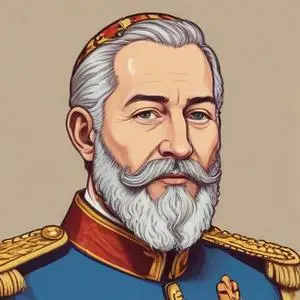
A brutal colonialist who exploited the Congo Free State for rubber and ivory, causing millions of deaths and atrocities. His reign was marked by greed, violence, and human rights abuses.
Leopold II of Belgium, also known as the Builder King, is infamous for his brutal and exploitative regime in the Congo Free State, which he ruled as a personal colony from 1885 to 1908. During this period, he amassed a vast fortune through the forced labor and exploitation of the native population, earning him the nickname "The Butcher of the Congo."
Leopold II was born on April 9, 1835, in Brussels, Belgium, as the second but eldest surviving son of King Leopold I and Queen Louise. He succeeded his father to the Belgian throne in 1865 and reigned for 44 years until his death, making him the longest-reigning Belgian monarch to date.
In 1885, Leopold II founded the Congo Free State, a private colonial project, which he ruled as a personal union with Belgium. He used Henry Morton Stanley to help him lay claim to the Congo, present-day Democratic Republic of the Congo. At the Berlin Conference of 1884-1885, European colonial nations authorized his claim and committed the Congo Free State to him.
Leopold's administration of the Congo Free State was characterized by systematic brutality and atrocities. He extracted a fortune from the territory through forced labor, torture, murder, kidnapping, and the amputation of hands of men, women, and children when the quota of rubber was not met. This regime of terror led to the deaths of millions of Congolese people.
Leopold II believed in the concept of "civilizing" the native population through forced labor and exploitation. He justified his actions as a means to bring "civilization" to the "savage" Congolese people. This paternalistic and racist ideology led to some of the worst human rights abuses in history.
Leopold II's brutal regime in the Congo had a profound impact on modern society. It led to the concept of "crimes against humanity" and the development of international humanitarian law. The atrocities committed in the Congo also sparked a global movement against colonialism and imperialism.
Leopold II's legacy is one of brutal exploitation and genocide. His regime in the Congo led to the deaths of millions of people and left a lasting impact on the region. Today, Leopold II is widely regarded as one of the most brutal colonial rulers in history.
Leopold II's regime in the Congo was more brutal than that of other European colonial powers. His personal ownership of the Congo Free State and his use of forced labor and exploitation set him apart from other colonial rulers of the time.

Timeline of Leopold II's life and key events in the Congo Free State.
Leopold II's regime in the Congo has inspired numerous literary and artistic works, including Joseph Conrad's "Heart of Darkness" and Adam Hochschild's "King Leopold's Ghost."
Despite his brutal regime in the Congo, Leopold II was a philanthropist in Belgium, supporting numerous charitable causes and institutions.
The story of Leopold II serves as a cautionary tale about the dangers of colonialism, imperialism, and the exploitation of vulnerable populations. It reminds us of the importance of protecting human rights and promoting social justice.
Born in 1892
The last emperor of Ethiopia, who led the country through a period of modernization and was a symbol of African independence, and is also revered as a deity by the Rastafari movement.
Born in 1819
The monarch who ruled the British Empire for 63 years, overseeing the Industrial Revolution and expanding the empire's reach, earning the nickname "the Grandmother of Europe".
Born in 1815
Unified Germany's founder, a master strategist who forged a nation through diplomacy and war, leaving a lasting legacy in European politics.
Born in 1811
The son of Napoleon Bonaparte, he was the titular Emperor of the French from 1811 to 1832, although he never actually ruled. He's known for his brief, tumultuous life and mysterious death.
Born in 1725
Reigned from 1774 to 1789, this Ottoman sultan implemented reforms, strengthened the military, and fought wars with Russia and Austria, leaving a lasting impact on the empire's politics and economy.
