


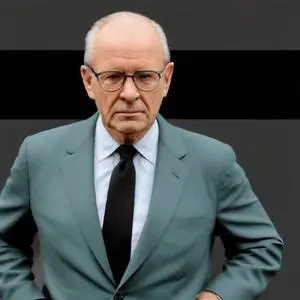
A CIA officer and author involved in the Watergate scandal, known for his role in the break-in and subsequent cover-up. He also wrote several spy novels.
Everette Howard Hunt Jr., a former CIA operative and author, is infamously known for his role in the Watergate scandal that rocked the Nixon administration in the 1970s. As a central figure in U.S. regime change in Latin America, Hunt's clandestine operations and literary endeavors have left an indelible mark on American history.
Born on October 9, 1918, in Hamburg, New York, Hunt was the son of Ethel Jean Totterdale and Everette Howard Hunt Sr., an attorney and Republican Party official. He attended Hamburg High School, graduating in 1936, before moving on to Brown University, where he earned his degree in 1940.
During World War II, Hunt served in the U.S. Navy on the destroyer USS Mayo and the U.S. Army Air Corps. He later joined the Office of Strategic Services (OSS), the precursor to the Central Intelligence Agency, serving in China.
Hunt's dual careers as a spy and novelist began in the 1940s. He wrote several novels under his own name, including East of Farewell (1942), Limit of Darkness (1944), and Stranger in Town (1947). Using pseudonyms such as Robert Dietrich, Gordon Davis, and David St. John, he penned spy and hardboiled novels, showcasing his versatility as a writer.
From 1949 to 1970, Hunt served as an officer in the Central Intelligence Agency (CIA), orchestrating regime changes in Latin America, including the 1954 Guatemalan coup d'état and the 1961 Bay of Pigs Invasion in Cuba.
Hunt's role as one of the Nixon administration's "White House Plumbers" led to his involvement in the Watergate burglaries and other clandestine operations. Alongside G. Gordon Liddy, Frank Sturgis, and others, Hunt was convicted of burglary, conspiracy, and wiretapping, and was sentenced to 33 months in prison.
After his release from prison, Hunt lived in Mexico and later Miami, where he continued to write novels until his death on January 23, 2007. His life's work, marked by espionage and literature, has left a lasting impact on American history and popular culture.
Hunt's clandestine operations and literary endeavors have influenced popular culture, inspiring films, literature, and television shows. His life's work serves as a testament to the complex and often blurred lines between espionage and literature.
Hunt's writing often explored themes of loyalty, duty, and the human condition, reflecting his own experiences as a spy and operative. His philosophical contributions lie in his ability to craft compelling narratives that navigate the complexities of the human experience.
95 Years Old
A former FBI agent turned Nixon operative, convicted for his role in the Watergate scandal, later becoming a radio host and TV actor. He's infamous for his involvement in the scandal that led to a presidential resignation.
Born in 1913
The 37th President of the United States, a polarizing figure who led the country through significant domestic and foreign policy changes, infamous for his involvement in the Watergate scandal.
Born in 1913
A high-ranking FBI official who secretly fed information to the press, helping to expose the Watergate scandal and bring down a presidency.
99 Years Old
A powerful and influential White House Chief of Staff who served under President Richard Nixon, known for his role in the Watergate scandal and subsequent cover-up.
Born in 1925
A key advisor to President Nixon, serving as White House Counsel and playing a central role in the Watergate scandal. He was convicted of conspiracy, obstruction of justice, and perjury.
Born in 1923
A renowned diplomat and strategist who played a pivotal role in shaping global politics during the Cold War era, known for his Realpolitik approach and brokering peace agreements .
83 Years Old
Investigative journalist and author renowned for uncovering the Watergate scandal, exposing government corruption, and writing bestselling books on American politics.
