


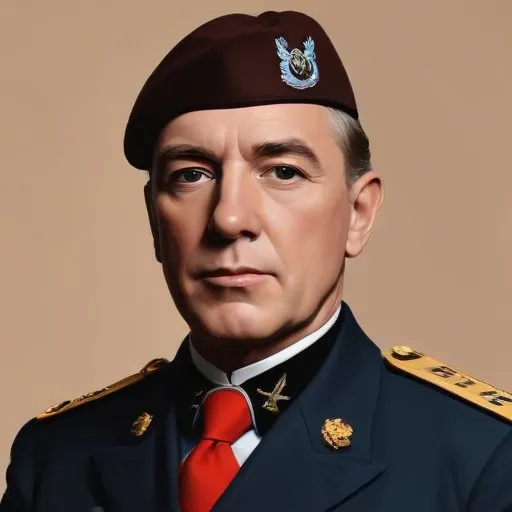
A four-star general who played a crucial role in the development of the United States Air Force, serving as its Vice Chief of Staff and commanding the Fifth Air Force during the Korean War.
Earle E. Partridge was a renowned four-star general in the United States Air Force, known for his exceptional leadership skills and distinguished service in various capacities. Throughout his illustrious career, he played a crucial role in shaping the Air Force's strategic operations, contributing significantly to its growth and development.
Born on July 7, 1900, in Winchendon, Massachusetts, Earle Partridge graduated from Ashby High School in 1917. He went on to enlist in the United States Army in July 1918, serving in the 5th Engineer Training Regiment. His military career was briefly interrupted when he studied at Norwich University for a year, before reenlisting in the Army in June 1920.
Partridge's military career gained momentum when he was sent to study at the United States Military Academy at West Point in August 1920. He graduated sixth in the class of 1924 and was commissioned in the Air Service. Subsequently, he received flight training at Brooks Field and Kelly Field, showcasing his exceptional piloting skills in the 1927 silent film Wings.
Partridge's military career was marked by several notable assignments and achievements. He taught mathematics at West Point, served as adjutant and assistant operations officer of the 1st Pursuit Group at Selfridge Field, and commanded the 94th Pursuit Squadron. He graduated from the Air Corps Tactical School in June 1937 and the Command and General Staff School in June 1938.
In 1943, Partridge became chief of staff of the Fifteenth Air Force, and was named deputy commander of the Eighth Air Force in 1944. He played a crucial role in the reorganization and movement of the 3rd Bomb Division to Okinawa, and later commanded the Fifth Air Force in Japan during the first year of the Korean War.
Earle E. Partridge's remarkable military career spanned over four decades, leaving an indelible mark on the United States Air Force. His leadership, strategic vision, and unwavering commitment to his country have inspired generations of military personnel. His legacy continues to be felt, serving as a testament to his exceptional dedication and service to the nation.
Earle E. Partridge's remarkable life and career serve as a shining example of dedication, perseverance, and leadership. His contributions to the United States Air Force have left a lasting impact, ensuring his legacy will continue to inspire future generations.
"The art of war is simple enough. Find out where your enemy is. Get at him as soon as you can. Strike him as hard as you can, and keep moving on."
This quote, attributed to Earle E. Partridge, reflects his unwavering commitment to his country and his unrelenting pursuit of excellence in military strategy and operations.
Born in 1890
Led the Allied forces to victory in World War II and later served as President, maintaining peace and prosperity during the Cold War era. He's known for his strategic leadership and diplomatic skills.
Born in 1893
Led the US Army in World War II and became the last five-star general, playing a crucial role in shaping post-war American military strategy. He's also known for his humble and unassuming leadership style.
Born in 1885
A renowned military leader who played a crucial role in World War II, particularly in the Allied victory in Europe, known for his bold tactics and unapologetic style.
Born in 1906
A pioneering Air Force general who played a crucial role in shaping the US military's strategic bombing capabilities during World War II and the Cold War. He's also known for his hawkish stance on communism and his influence on US foreign policy.
Born in 1891
Led the US Air Forces to victory in World War II, pioneering the use of strategic bombing and playing a crucial role in shaping the US military's air power.
Born in 1896
Led a daring bombing raid on Tokyo in 1942, earning the Medal of Honor for his bravery and helping to turn the tide of World War II.
Born in 1899
A pioneering Air Force general who played a crucial role in shaping the US military's air power and intelligence capabilities during the early Cold War era. He was a key figure in the development of the US Air Force as a separate branch of the military.
