


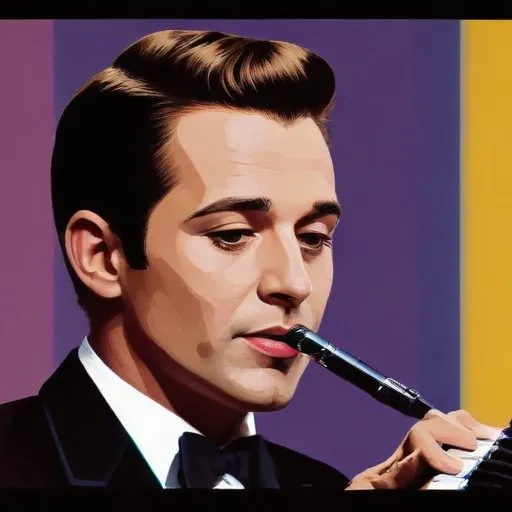
A talented pianist and bandleader of the 1930s and 1940s, known for his charismatic stage presence and elegant, melodic style, which captivated audiences and influenced future musicians.
Eddy Duchin, the American popular music pianist and bandleader, left an indelible mark on the music industry during the 1930s and 1940s. With his unique blend of classical music and sweet melodies, Duchin became a household name, dominating the airwaves and record sales.
Born on April 1, 1909, in Cambridge, Massachusetts, to Bessarabian Jewish immigrant parents, Duchin's early life was far from music. He graduated from Beverly High School and attended the Massachusetts College of Pharmacy, where he earned a degree in pharmacy. However, his true calling lay in music, and he soon began performing with Leo Reisman's orchestra at the Central Park Casino in New York.
Duchin's talent and charisma soon propelled him to the forefront, causing tension between him and Reisman. In 1932, Reisman's contract was terminated, and Duchin took over as the leader of the orchestra. This marked the beginning of his solo career, which would span over two decades.
Duchin's music defied categorization, lying somewhere between classical and sweet music. His lack of formal music training often frustrated his musicians, but he developed a distinct style that captivated audiences. This style, rooted in classical music, paved the way for other pianist-bandleaders like Carmen Cavallaro, who openly acknowledged Duchin's influence.
Duchin's music was characterized by its pleasing stage presence, easy listening quality, and subtle nuances that set him apart from other pianists. While not a virtuoso, Duchin's music was far from rote or predictable, making him a favorite among music lovers.
Duchin's popularity soared with regular radio broadcasts, which significantly boosted his record sales. He became one of the first pianists to lead a commercially successful large band, paving the way for future generations of musicians.
His music transcended genres, appealing to a wide audience and earning him a spot among the elite of popular music. Duchin's fame extended beyond the United States, with his music enjoyed by people from all walks of life.
Despite his meteoric rise to fame, Duchin's personal life remained relatively low-key. He married Marjorie Oelrichs in 1935, and the couple had two children, Peter and Patricia. Duchin's family life was marked by tragedy, including the loss of his son Peter to leukemia in 1943.
Throughout his life, Duchin remained humble and grounded, surrounded by his family and friends. His passing on February 9, 1951, at the age of 41, sent shockwaves through the music world, leaving behind a legacy that continues to inspire and delight music lovers to this day.
Eddy Duchin's influence on popular music is undeniable. He opened doors for pianist-bandleaders, redefined the sweet music genre, and left an indelible mark on the music industry. His legacy extends beyond his own music, with his style and influence still resonating in contemporary music.
In conclusion, Eddy Duchin's life and career serve as a testament to the power of talent, hard work, and dedication. His music continues to captivate audiences, and his influence will forever be etched in the annals of music history.
Born in 1910
A virtuosic clarinetist and innovative bandleader, he revolutionized the swing era with his unique sound and iconic hits like "Begin the Beguine" and "Stardust".
Born in 1909
A virtuosic clarinetist and bandleader, known as the "King of Swing," who revolutionized jazz music with his energetic and sophisticated style, leading a racially integrated orchestra in the 1930s.
Born in 1904
A legendary trombonist, composer, and bandleader who led one of the most popular big bands of the 1930s and 1940s, creating iconic hits like "In the Mood" and "Moonlight Serenade".
Born in 1905
A legendary trombonist, composer, and bandleader of the Big Band era, known for his smooth, melodic style and iconic hits like "I'll Never Smile Again" and "Opus No. 1".
Born in 1916
A legendary trumpet virtuoso and charismatic bandleader, known for his technical brilliance and romantic ballads, as well as his film appearances alongside iconic stars like Betty Grable.
Born in 1912
A renowned saxophonist, composer, and bandleader, known for his iconic big band sound and hits like "Sentimental Journey" and "My Heart Belongs to Daddy".
Born in 1899
A legendary jazz pianist, composer, and bandleader who revolutionized the genre with his unique style and iconic compositions, such as "Take the A Train" and "Mood Indigo".
Born in 1904
A legendary jazz pianist and bandleader who led a iconic orchestra, blending swing and blues to create a unique sound that influenced generations of musicians. Known for his distinctive "less-is-more" style and hits like "April in Paris" and "One O'Clock Jump".
