


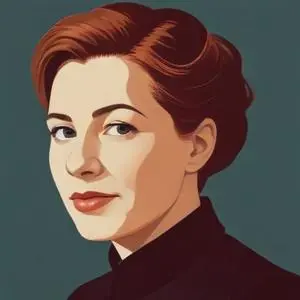
Pioneering electrical engineer who developed innovative methods for calculating power transmission lines, revolutionizing the field of electrical engineering. Known for being the first woman to achieve professional recognition in her field.
Edith Clarke was a trailblazing American electrical engineer who shattered glass ceilings in a male-dominated field. She was the first woman to be professionally employed as an electrical engineer in the United States, and the first female professor of electrical engineering in the country.
Born on February 10, 1883, in Howard County, Maryland, Edith Clarke was one of nine children to John Ridgely Clarke and Susan Dorsey Owings. After being orphaned at the age of 12, she was raised by an older sister. Clarke's inheritance enabled her to study mathematics and astronomy at Vassar College, where she graduated in 1908.
Clarke's academic journey continued as she taught mathematics and physics at a private school in San Francisco and at Marshall College. She then pursued civil engineering at the University of Wisconsin-Madison but left to work as a computer at AT&T in 1912. During her time at AT&T, she studied electrical engineering at Columbia University by night.
In 1918, Clarke enrolled at the Massachusetts Institute of Technology (MIT), where she became the first woman to earn an M.S. in electrical engineering in 1919. Her thesis, supervised by Arthur E. Kennelly, was titled "Behavior of a Lumpy Artificial Transmission Line as the Frequency is Indefinitely Increased."
Clarke's groundbreaking work in electrical power system analysis led to the publication of her book, Circuit Analysis of AC Power Systems. This seminal work revolutionized the field of electrical engineering and cemented her reputation as a pioneer in the field.
Clarke's remarkable achievements were recognized by several esteemed organizations. She was the first female engineer to be recognized by Tau Beta Pi, the oldest engineering honor society in the United States. Additionally, she was the first woman to be named a Fellow of the American Institute of Electrical Engineers (AIEE).
Edith Clarke's trailblazing career paved the way for future generations of women in STEM fields. Her remarkable achievements continue to inspire and motivate individuals to pursue careers in engineering and beyond.
Edith Clarke's remarkable journey serves as a testament to her unwavering dedication, perseverance, and passion for her craft. Her pioneering spirit continues to inspire generations, ensuring her legacy endures as a beacon of excellence in the field of electrical engineering.
Born in 1846
Developed innovative braking systems for trains, revolutionizing rail safety and transforming the industry. Founded a company that dominated the market for over a century.
Born in 1856
A pioneering engineer who harnessed the power of alternating current (AC) to transform the world's electrical systems, and is credited with developing groundbreaking technologies like radio communication and X-ray imaging.
Born in 1847
A pioneer in innovation, credited with developing groundbreaking inventions that revolutionized the way people live and communicate, including the light bulb and phonograph.
Born in 1847
A Scottish-American engineer and academic credited with inventing the telephone, revolutionizing real-time communication. This innovation transformed the way people connect and conduct business.
Born in 1873
Invented the Audion tube, a type of vacuum tube that revolutionized radio communication and paved the way for modern electronics. This innovation enabled the amplification of weak electrical signals, transforming the field of communication.
Born in 1853
Developed groundbreaking inventions and innovations in electrical engineering, including the first practical welding machine and the first electric streetcar system.
Born in 1791
Pioneering scientist who discovered electromagnetic induction, formulated the laws of electrolysis, and invented the first electrical generator, revolutionizing our understanding of electricity and its applications.
Born in 1831
Developed groundbreaking theories that unified electricity and magnetism, and predicted the existence of radio waves, revolutionizing our understanding of the physical world.
