


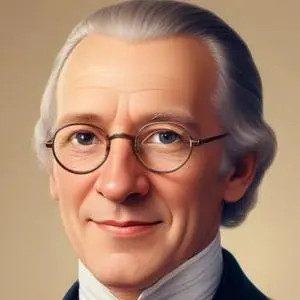
An English clergyman and engineer who revolutionized the textile industry by inventing the power loom, a machine that enabled mass production of cloth. This innovation had a significant impact on the Industrial Revolution.
Edmund Cartwright, a trailblazing English inventor, is renowned for designing the power loom, a groundbreaking innovation that transformed the textile industry forever. His pioneering work in the late 18th century paved the way for the mechanization of weaving, rendering the process faster, more efficient, and less labor-intensive.
Born on April 24, 1743, in Marnham, Nottinghamshire, Cartwright was the fourth son of William Cartwright and his wife Anne. He received his early education at Queen Elizabeth Grammar School, Wakefield, before matriculating at University College, Oxford, in 1760. Cartwright went on to graduate with a Bachelor of Arts degree in 1764 and a Master of Arts degree in 1766.
Before delving into the world of inventing, Cartwright was ordained as a deacon in the Church of England in 1765 and later as a priest in 1767. He served as rector of Kilvington in 1767 and subsequently held other livings, including Goadby Marwood, Leicestershire, in 1779. Cartwright also acted as chaplain to the Duke of Bedford at Woburn Abbey and tutored the Duke's son, the future Prime Minister Lord John Russell.
In 1784, Cartwright designed his first power loom, which he patented the following year. Although his initial design was more of a proof of concept, it laid the foundation for later innovators to build upon. Cartwright's invention was ahead of its time, and it wasn't until 1809 that he received a grant of £10,000 from Parliament for his contribution to the textile industry.
In 1789, Cartwright patented another loom that served as a model for subsequent inventors. His work on the power loom paved the way for the development of mechanized weaving, which had a profound impact on the textile industry and beyond.
Cartwright's invention of the power loom revolutionized the textile industry, increasing efficiency and reducing labor costs. His work had far-reaching consequences, contributing to the Industrial Revolution and shaping the modern manufacturing landscape.
Today, Cartwright is remembered as a pioneering figure in the history of innovation, and his legacy continues to inspire future generations of inventors and entrepreneurs.
In 1764, Cartwright married Elizabeth McMac, and the couple had several children together. Cartwright was also a generous philanthropist, using his wealth to support charitable causes and promote education.
In his later years, Cartwright resided on a small farm in Kent, where he spent his time pursuing his passion for innovation and philanthropy. He passed away on October 30, 1823, at the age of 80, leaving behind a lasting legacy in the world of science and industry.
Though Cartwright's quotes and sayings are not well-documented, his legacy speaks for itself. As a testament to his innovative spirit, we can infer that he believed in the power of human ingenuity to shape the future.
Born in 1732
Innovative entrepreneur and inventor credited with revolutionizing the textile industry through his pioneering machinery designs, transforming manufacturing processes forever.
82 Years Old
A German-Canadian singer-songwriter, guitarist, and producer, known for his eclectic style blending rock, folk, and blues, and as the frontman of the rock band Steppenwolf. He's famous for hits like "Born to Be Wild" and "Magic Carpet Ride".
Born in 1781
Designed the Liverpool and Manchester Railway, a pioneering feat that revolutionized transportation and paved the way for modern rail networks.
Born in 1791
Pioneering scientist who discovered electromagnetic induction, formulated the laws of electrolysis, and invented the first electrical generator, revolutionizing our understanding of electricity and its applications.
Born in 1791
A pioneer in computer science, credited with inventing the first mechanical computer, the Difference Engine, and conceptualizing the Analytical Engine, a precursor to modern computers.
