


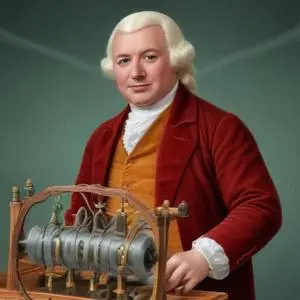
Innovative entrepreneur and inventor credited with revolutionizing the textile industry through his pioneering machinery designs, transforming manufacturing processes forever.
Richard Arkwright, a pioneering English inventor and entrepreneur, revolutionized the textile industry during the early Industrial Revolution. He is credited with developing the spinning frame, also known as the water frame, which harnessed water power to mechanize the spinning process, and patented a rotary carding engine to convert raw cotton into cotton lap prior to spinning.
Born on December 23, 1732, in Preston, Lancashire, England, Richard Arkwright was the youngest of seven surviving children to Thomas and Sarah Arkwright. Despite his parents' humble means, they arranged for him to be taught to read and write by his cousin Ellen. Arkwright began his working life as a barber and wigmaker, setting up a shop in Bolton in the early 1760s, where he invented a waterproof dye for periwigs, which later funded his prototype cotton machinery.
Arkwright's most significant achievement was combining power, machinery, semi-skilled labor, and cotton to create mass-produced yarn. He developed factories housing mechanized carding and spinning operations, earning him the title "father of the modern industrial factory system." His innovative methods, developed in his mill at Cromford, Derbyshire, are now preserved as part of the Derwent Valley Mills World Heritage Site.
Arkwright married Patience Holt in 1755, and they had a son, Richard Arkwright Junior, the same year. After Patience's death in 1756, Arkwright married Margaret Biggins in 1761, with whom he had three children, only one of whom, Susannah, survived to adulthood.
Arkwright's innovations had a profound impact on modern society, transforming the textile industry and paving the way for the Industrial Revolution. His factory system became a model for industrial production, influencing the development of factories worldwide. Today, Arkwright is remembered as a pioneer who combined entrepreneurship, innovation, and organizational skills to create a new era of industrial production.
Richard Arkwright's innovative spirit, entrepreneurial drive, and organizational skills transformed the textile industry and paved the way for the Industrial Revolution. His legacy continues to inspire generations of inventors, entrepreneurs, and industrialists, earning him a permanent place in history as the father of the modern industrial factory system.
Born in 1768
Built America's first successful cotton mill, revolutionizing the textile industry and earning the nickname "Father of American Industry".
Born in 1765
An American engineer revolutionized the cotton industry with a machine that simplified harvesting, making cotton production more efficient and profitable. This innovation had a significant impact on the economy and society.
Born in 1663
A Puritan minister and writer who advocated for the use of inoculation against smallpox and wrote influential books on witchcraft, including "Memorable Providences, Relating to Witchcrafts and Possessions".
Born in 1806
A visionary engineer who revolutionized transportation with innovative designs, including the iconic Clifton Suspension Bridge, which transformed urban landscapes.
Born in 1736
Improved steam engine efficiency, revolutionizing industry and transportation. Known for his innovative designs and patents that transformed the Industrial Revolution.
Born in 1771
Built steam-powered locomotives, revolutionizing land transportation, and pioneered the use of steam engines in mines.
Born in 1781
Designed the Liverpool and Manchester Railway, a pioneering feat that revolutionized transportation and paved the way for modern rail networks.
Born in 1791
Pioneering scientist who discovered electromagnetic induction, formulated the laws of electrolysis, and invented the first electrical generator, revolutionizing our understanding of electricity and its applications.
