


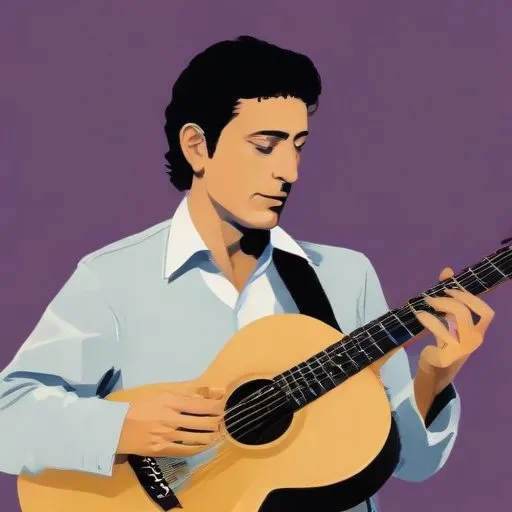
A renowned classical guitarist and composer, known for his expressive and nuanced performances, as well as his contributions to the Argentine guitar repertoire.
Eduardo Fal, the renowned Argentine folk music guitarist and composer, is synonymous with the traditional sounds of the Argentine Northwest. With a career spanning over six decades, Fal is credited with creating Argentina's modern folk song movement, leaving an indelible mark on the country's musical landscape.
Born on July 7, 1923, in El Galpón, a village near San José de Metán in the province of Salta, Fal was raised in rural surroundings that instilled in him a deep appreciation for the region's folk traditions. His parents, Fada and Juan Fal, Syrian immigrants, encouraged his love for music, gifting him his first guitar during childhood.
Fal's talent and dedication earned him recognition in the 1940s, forming a duo with Csar Perdiguero that became a staple in the region. His increasing popularity led him to Buenos Aires in 1945, where he recorded his first album in 1950. Collaborations with prominent Argentine poets, such as Jaime Dvalos, resulted in some of his most iconic compositions, including "Zamba de la Candelaria," "Trago de sombra," and "Canción del jangadero."
Fal's music transcended borders, with his first international performance in Paris in 1959. This was followed by performances in Rome, Los Angeles, Madrid, and numerous other cultural capitals. His music resonated particularly with the Japanese, where he performed over 200 times between 1963 and 1973.
Fal believed that folk music was "something lively, dynamic, and evolutionary." He saw his role as a guardian of traditional music, while also innovating and pushing boundaries. His compositions, which exceeded 150 poems set to music, reflect his commitment to preserving Argentina's cultural heritage.
Fal's nephew, Juan Fal, often accompanied him on stage, creating a unique family legacy. His performances and compositions were enriched by his relationships with Argentine literary giants, such as Jorge Luis Borges and Ernesto Sabha.
Eduardo Fal's contributions to Argentine folk music are immeasurable. He inspired generations of musicians, ensuring the continuation of traditional music. His music remains an integral part of Argentina's cultural identity, with his legacy continuing to inspire and enrich the country's musical landscape.
Eduardo Fal passed away on August 9, 2013, leaving behind a rich musical legacy that continues to captivate audiences worldwide. His music remains a testament to his dedication, passion, and love for Argentine folk traditions.
Born in 1921
Revolutionized Argentine tango with bold, jazz-infused compositions and virtuosic bandoneon playing, blending traditional and modern styles. His music evokes passion, drama, and sensuality.
Born in 1899
A virtuosic violinist, composer, and conductor who revolutionized Argentine tango music with his innovative and expressive style, blending traditional folk with classical and jazz elements.
