


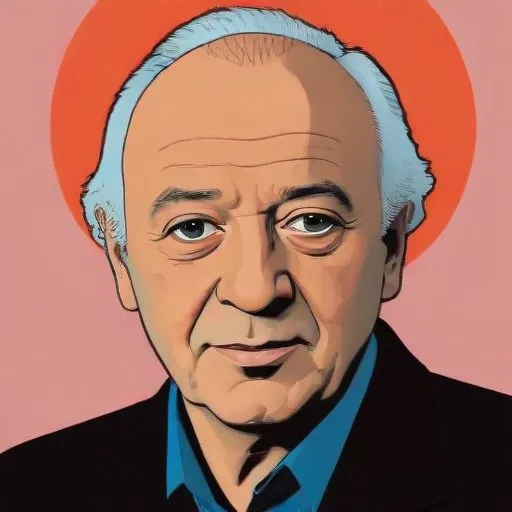
A Uruguayan journalist and author who wrote poetic and poignant accounts of Latin American history and politics, blending fiction and nonfiction to convey the struggles of the marginalized.
Eduardo Galeano, the renowned Uruguayan journalist, writer, and novelist, is widely regarded as a literary giant of the Latin American left and global soccer's preeminent man of letters. His most celebrated works, Las venas abiertas de América Latina (Open Veins of Latin America) and Memoria del fuego (Memory of Fire Trilogy), have left an indelible mark on the literary world.
Born on September 3, 1940, in Montevideo, Uruguay, Galeano was the product of a mixed heritage, with Welsh, Italian, German, and Spanish roots. His family, once part of the Uruguayan aristocracy, had fallen on hard times, and Galeano was forced to work multiple jobs from a young age, including as a messenger and fare collector.
Despite the challenges, Galeano's passion for writing and drawing propelled him towards a career in journalism. At 14, he began working for the Uruguayan socialist weekly, El Sol, where he initially published his comics before transitioning to writing. His signature, often accompanied by a small hand-drawn pig, would become a hallmark of his work.
Galeano's most iconic work, Open Veins of Latin America, is a meticulously researched and passionately written account of the region's history, from the Spanish conquest to the present day. This seminal work has been hailed as a masterpiece of storytelling, weaving together meticulous detail, political conviction, and poetic flair.
The Memory of Fire Trilogy, comprising Genesis, Faces and Masks, and Century of the Wind, is another landmark contribution to Latin American literature. This sweeping narrative explores the region's history, mythology, and culture, earning Galeano a reputation as a master chronicler of the continent's soul.
Galeano's work has inspired a generation of writers, intellectuals, and activists, including Nobel laureate Isabel Allende, who credits Open Veins of Latin America as one of the few possessions she took with her when fleeing Chile in 1973.
His writing has also had a profound impact on modern society, influencing the way people think about Latin American history, politics, and culture. Galeano's commitment to social justice and his critiques of imperialism and neoliberalism have made him a beacon for those seeking a more equitable and just world.
Galeano was known for his humility, humor, and kindness. A self-proclaimed "obsessive rememorizer," he was driven by a passion for remembering the past, particularly the history of Latin America, which he believed was condemned to amnesia.
Throughout his life, Galeano remained committed to his craft, continuing to write and draw until his passing on April 13, 2015. His legacy lives on through his work, a testament to the power of storytelling and the importance of remembering our collective past.
Galeano received numerous awards and honors for his work, including the prestigious Casa de las Américas Prize, the Stig Dagerman Prize, and the José María Arguedas Prize.
Eduardo Galeano's life and work serve as a testament to the power of storytelling, creativity, and commitment to social justice. As a writer, journalist, and human being, he continues to inspire generations, challenging us to remember, to question, and to dream of a better world.
90 Years Old
A Nobel Prize-winning writer and politician who explored the complexities of Peruvian society through his novels and essays, and later ran for president. His works often blended politics, history, and fiction.
Born in 1914
A pioneering figure in magical realism, blending fantastical elements with everyday life in his novels and short stories, exploring the human condition and social commentary.
Born in 1904
A Chilean poet and diplomat who wrote passionate and evocative poetry that explored love, politics, and the human condition, and was awarded the Nobel Prize in Literature in 1971.
Born in 1914
A Mexican poet and diplomat who won the Nobel Prize in Literature in 1990 for his work that explores the intersection of poetry, philosophy, and politics. He's known for his lyrical and introspective style that explores the human condition.
97 Years Old
A renowned Mexican writer, celebrated for his novels and essays that explored the complexities of Mexican identity, politics, and culture. His works often blended mythology, history, and fantasy to create a unique narrative style.
Born in 1920
A renowned Uruguayan writer and journalist, celebrated for his poignant poetry and novels that capture the essence of love, politics, and social justice. His works are a testament to the power of literature in shaping cultural identity.
96 Years Old
A celebrated poet and author, known for his lyrical and socially conscious works that explored themes of love, politics, and human rights. His writing often reflected his experiences as a political exile and his quest for social justice.
84 Years Old
A Chilean-American writer who weaves magical realism into her novels, exploring themes of love, family, and social justice, captivating readers worldwide with her lyrical prose.
