


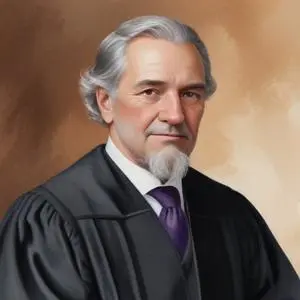
The 9th Chief Justice of the United States, serving from 1910 to 1921, known for his role in shaping the Court's decisions on issues like federal power and individual rights.
Edward Douglass White, a stalwart of American jurisprudence, is renowned for his 27-year tenure on the United States Supreme Court, including nine years as the ninth Chief Justice of the United States. His legacy is inextricably linked to the landmark case of Plessy v. Ferguson, in which he sided with the majority to uphold the legality of state segregation, leading to the infamous "separate but equal" doctrine.
Born on November 3, 1845, on his family's sugar plantation near Thibodaux, Louisiana, White was nurtured in an environment steeped in politics and law. His father, Edward Douglass White Sr., was a prominent Whig US Representative and the 10th Governor of Louisiana. White's educational pursuits took him to the College of the Immaculate Conception (present-day Jesuit High School in New Orleans), where he graduated in 1865, and later to the University of Louisiana (now Tulane University), where he studied law.
White's jurisprudential philosophy was shaped by his experiences as a Southerner, a Democrat, and a pragmatic jurist. While his decision in Plessy v. Ferguson has been widely criticized, it reflected his commitment to the concept of state rights and his reluctance to interfere with local laws. Throughout his career, White struggled to balance individual rights with the need for social order and national unity.
Edward Douglass White's legacy is complex and multifaceted. While his role in upholding segregation has been roundly criticized, he also played a crucial role in shaping the Supreme Court's approach to issues such as tribal sovereignty, voting rights, and war powers. As Chief Justice, he worked tirelessly to modernize the Court's procedures and Increase its efficiency. White's commitment to the rule of law and his dedication to public service have earned him a place among the most influential jurists in American history.
Edward Douglass White's life was marked by personal and professional milestones, including his marriage to Nancy Johnson in 1868 and the birth of their three children. His long and distinguished career was punctuated by moments of triumph and controversy, ultimately ending with his passing on May 19, 1921.
Born in 1841
A renowned Supreme Court Justice, he penned influential opinions that shaped American law, particularly in the areas of free speech and judicial restraint.
Born in 1857
The 27th President of the United States was a lawyer and jurist who served as the only person to hold the offices of President and Chief Justice of the United States. He's known for his significant contributions to the country's judicial system.
Born in 1858
A pioneering leader who championed progressive reforms, trust-busting, and conservation, earning a Nobel Peace Prize for mediating the Russo-Japanese War. He's also famous for his rugged outdoorsmanship and "big stick" diplomacy.
Born in 1856
The 28th President of the United States, a Nobel Peace Prize winner, and a historian who played a key role in shaping international relations and global governance after World War I. He's most known for his idealistic vision of a League of Nations and his efforts to promote peace and diplomacy.
Born in 1865
The 29th President of the United States, a journalist-turned-politician, led the country through a period of post-war prosperity and scandalous corruption. He's infamous for his administration's numerous scandals and his own extramarital affairs.
Born in 1862
A prominent lawyer and politician who served as the 44th Secretary of State, known for his influential decisions and diplomatic efforts in shaping international relations. He played a key role in resolving the Mexican Revolution crisis.
Born in 1856
A pioneering lawyer and jurist who championed individual rights and freedoms, shaping the course of American law and democracy through landmark Supreme Court decisions.
Born in 1849
The 36th United States Secretary of State served from 1898 to 1905, playing a key role in shaping American foreign policy during the Spanish-American War and beyond. He's most known for his diplomatic efforts in the Philippines and China.
