


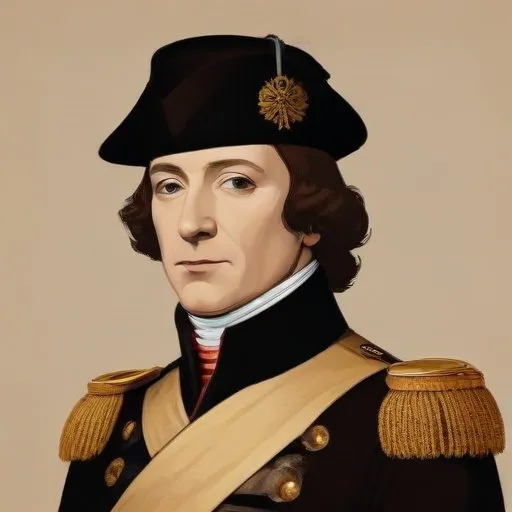
A British aristocrat who served as a colonial governor of New York and played a significant role in the British military and politics during the 17th century. He's known for his efforts to establish a British foothold in North America.
Edward Hyde, 3rd Earl of Clarendon, also known as Viscount Cornbury, was a prominent English aristocrat and politician who played a crucial role in shaping the course of English politics during the late 17th and early 18th centuries. He is perhaps best known for his defection from Catholic King James II to support Protestant contender William III of Orange, a pivotal move that contributed to the Glorious Revolution of 1688.
Born on November 28, 1661, Edward Hyde was styled Viscount Cornbury from 1674 to 1709. He was propelled into the forefront of English politics when he defected from King James II to support William III of Orange, a decision that would have far-reaching consequences for his career and the country.
In 1688, Cornbury's defection to William III's camp was a significant blow to King James II, who was ultimately overthrown in the Glorious Revolution. Although Cornbury's decision cost him his military commission, his support for William III eventually earned him the governorship of the provinces of New York and New Jersey, which he served from 1701 to 1708.
As a High Tory governor, Cornbury's primary mission was to protect the colonies during the War of the Spanish Succession, also known as Queen Anne's War. His administration successfully prevented French incursions into the middle colonies, but he became mired in factional conflicts and accrued powerful political enemies, including Lewis Morris, who would later become Governor of New Jersey.
By 1708, war weariness led to a shift in the political tide in Great Britain, and Cornbury was recalled from the colonies. He was soon installed as a member of Queen Anne's privy council, but his fortunes changed again when George I was crowned King of Great Britain in 1714. Out of favour, Lord Cornbury died in Chelsea, London on March 31, 1723.
Cornbury's conduct as governor has been remembered as scandalous, with accusations of cross-dressing, moral profligacy, and corruption. While modern writers disagree as to whether these allegations are true or not, Cornbury's legacy remains a topic of debate among historians.
Edward Hyde, 3rd Earl of Clarendon, played a significant role in shaping English politics during a time of great upheaval. His defection from King James II to William III of Orange contributed to the Glorious Revolution, and his subsequent governorship of New York and New Jersey had far-reaching consequences for the colonies. Although his legacy is marred by controversy, Cornbury remains an important figure in English history.
Edward Hyde, 3rd Earl of Clarendon, was a complex and multifaceted figure who played a significant role in shaping English politics during a time of great change. While his legacy is marked by controversy, his contributions to the Glorious Revolution and his governorship of New York and New Jersey remain an important part of English history.
Born in 1599
Leader of the Parliamentarian forces during the English Civil War, who later ruled England, Scotland, and Ireland as a republican dictator, known for his military victories and radical reforms.
Born in 1490
A powerful French nobleman who ruled as Constable of France and led the country's army during the Italian Wars, known for his military prowess and strategic alliances.
Born in 1562
Margrave of Baden-Hachberg, a 15th-century German nobleman who ruled over the Margraviate of Baden-Hachberg and played a significant role in the region's politics and history.
Born in 1484
A German nobleman who ruled Brandenburg-Ansbach from 1486 to 1515, known for his military campaigns and territorial expansions. He played a significant role in shaping the region's history.
Born in 1676
The first Prime Minister of the United Kingdom, serving from 1721 to 1742, known for establishing the office of Prime Minister and setting important precedents for the role. He is also recognized for his skill in managing Parliament and his role in shaping British politics.
Born in 1694
The Prime Minister who led Britain through a period of relative peace and stability, and is often credited with being the first Prime Minister in the modern sense, holding office from 1743 to 1754.
