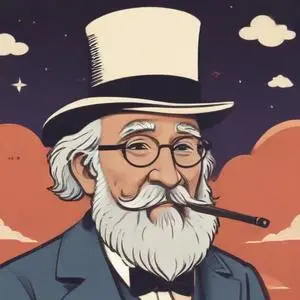
Edward Lear: The Master of Literary Nonsense
The King of Limericks and Whimsical Wordsmith
Edward Lear is renowned for his infectious brand of literary nonsense, which has captivated readers of all ages with its absurdity, wit, and sheer playfulness. He is, of course, the mastermind behind the beloved limerick, a poetic form he popularized and elevated to an art form.
A Life of Artistic Expression
Lear's creative trajectory was marked by three distinct phases. As a draughtsman, he was employed to illustrate birds and animals, which would later become a staple of his travel books. His journeys inspired a collection of colored drawings, often reworked as plates for his publications. Additionally, he dabbled in illustrations for
Alfred, Lord Tennyson's poems, solidifying his reputation as a minor illustrator of note.
Author of Whimsy and Wonder
Lear's literary output is a testament to his boundless imagination and love of words. His popular nonsense collections feature poems, songs, short stories, botanical drawings, recipes, and alphabets, all infused with his signature blend of humor and absurdity. Notably, he composed and published twelve musical settings of Tennyson's poetry, further showcasing his artistic versatility.
A Turbulent Early Life
Born on May 12, 1812, in Holloway, North London, Lear was the penultimate of 21 children to Ann Clark Skerrett and Jeremiah Lear, a stockbroker. His family's financial struggles, compounded by his father's default to the London Stock Exchange, forced Lear and his eldest sister, Ann, to leave their family home and live together when he was just four years old. This early upheaval would have a lasting impact on his life and art.
Health Struggles and Creative Triumphs
Lear's life was marked by various health issues, including grand mal epileptic seizures, bronchitis, asthma, and partial blindness. Despite these challenges, he persevered, pouring his energy into his art and writing. His adult diaries reveal a deep sense of guilt and shame surrounding his epilepsy, which he learned to manage and conceal from public view.
A Legacy of Laughter and Imagination
Edward Lear's impact on modern literature is immeasurable. His unique brand of nonsense has inspired generations of writers, poets, and artists. His limericks, in particular, have become an integral part of the cultural lexicon, with their catchy rhythms and absurd scenarios.
Selected Works
- A Book of Nonsense (1846)
- Nonsense Songs, Stories, Botany, and Alphabets (1871)
- Laughable Lyrics, a Fourth Book of Nonsense (1876)
- Queery Leary Nonsense (1882)
A Life of Quiet Contemplation
Lear's later years were marked by a desire for solitude and quiet contemplation. He settled in Sanremo, Italy, where he continued to write and draw until his passing on January 29, 1888. His legacy, however, endures, a testament to the power of imagination and creativity to transcend the boundaries of time and space.
FAQ
What is Edward Lear known for?
Edward Lear is known for his childrens books, particularly A Book of Nonsense and Laughable Lyrics, which featured his iconic blend of absurdity and whimsy. His works are still widely popular today, with their unique style and language.
What inspired Edward Lears writing style?
Edward Lears writing style was largely inspired by his love of nonsense verse and his experiences as a tutor to the children of King Charles of Portugal. He was also influenced by his travels to Greece, Albania, and Egypt, which inspired his poetic imagination.
What is the significance of Edward Lears illustrations?
Edward Lears illustrations are an integral part of his work, featuring fantastical creatures and landscapes that bring his poetry to life. His unique illustration style, which blended traditional and modern techniques, has been widely praised and emulated.
How did Edward Lears work influence childrens literature?
Edward Lears work had a profound influence on childrens literature, paving the way for later authors such as Lewis Carroll and Dr. Seuss. His use of absurdity and nonsense verse helped to create a new genre of childrens literature that emphasized imagination and creativity.
What is Edward Lears legacy?
Edward Lears legacy is that of a beloved childrens author and poet, whose work continues to delight readers of all ages. He is also remembered for his innovative use of language and illustration, which have inspired generations of writers and artists.