


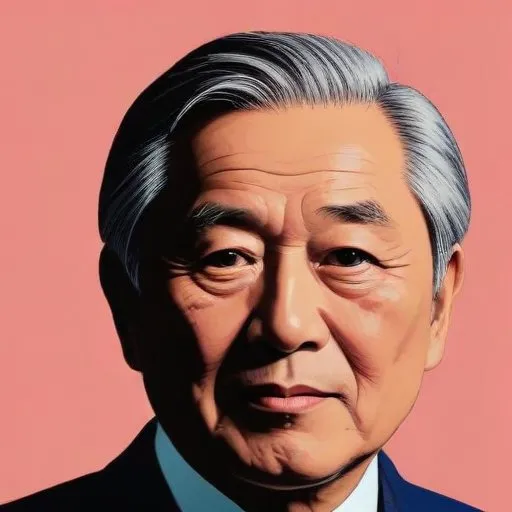
A Japanese politician who served as Prime Minister from 1964 to 1972, known for his efforts to normalize relations with South Korea and winning the Nobel Peace Prize in 1974.
Eisaku Sat, a Japanese politician, served as the Prime Minister of Japan from 1964 to 1972, earning recognition as the third longest-serving prime minister and second in longest uninterrupted service. He is renowned for presiding over a period of rapid economic growth, fostering Japan's economic miracle, and securing the formal return of Okinawa Ryukyu Islands from the United States.
Born on March 27, 1901, in Tabuse, Yamaguchi Prefecture, Sat was the third son of businessman Hidesuke Sat and his wife Moyo. His family had a rich history in sake brewing and held the right for sake brewing for generations. Sat's great-grandfather was a samurai of the Choshu Domain, which had significant influence in Meiji era Japan.
Sat studied German law at Tokyo Imperial University and passed the senior civil service examinations in 1923. Upon graduation the following year, he became a civil servant in the Ministry of Agriculture and Commerce.
Sat entered the National Diet in 1949 as a member of the Liberal Party. He gradually rose through the ranks of Japanese politics, holding a series of cabinet positions. His brother, Nobusuke Kishi, served as prime minister from 1957 to 1960.
In 1964, Sat succeeded Hayato Ikeda as prime minister, becoming the first prime minister born in the 20th century. He was the second prime minister to come from the Sat-Kishi-Abe family.
During his tenure as prime minister, Sat oversaw a period of rapid economic growth, often referred to as the Japanese post-war economic miracle. He implemented policies that promoted industrial development, investment in infrastructure, and encouraged foreign trade.
Sat also played a crucial role in international diplomacy. In 1972, he arranged for the formal return of Okinawa Ryukyu Islands from the United States, which had occupied the islands since the end of World War II.
In 1974, Sat was awarded the Nobel Peace Prize as a co-recipient for his efforts in bringing Japan into the Nuclear Non-Proliferation Treaty.
Sat's leadership and policies had a profound impact on modern Japan. He fostered economic growth, promoted international cooperation, and strengthened Japan's position in the global community.
Today, Sat is remembered as one of Japan's most influential prime ministers, leaving behind a legacy of economic prosperity and international diplomacy.
Born in 1878
A post-WWII Japanese leader who played a crucial role in rebuilding and democratizing Japan, known for his efforts to restore relations with the West.
Born in 1899
The 58th Prime Minister of Japan, a key figure in Japan's post-war economic growth and international relations, known for his role in shaping the country's modern economy.
Born in 1918
A Japanese politician who served as Prime Minister from 1972 to 1974, known for his economic policies and corruption scandals. He is infamous for his involvement in the Lockheed bribery scandal.
Born in 1905
The 67th Prime Minister of Japan, serving from 1976 to 1978, known for his efforts to improve Japan's relations with Southeast Asia and his role in normalizing Japan's relations with China.
Born in 1910
The 68th Prime Minister of Japan, known for his efforts to revitalize the country's economy and reform its political system, leaving a lasting impact on Japan's modernization.
Born in 1918
A Japanese politician who served as Prime Minister from 1982 to 1987, known for his efforts to revitalize the Japanese economy and strengthen ties with the US. He's also remembered for his nationalist views and controversial visits to the Yasukuni Shrine.
