


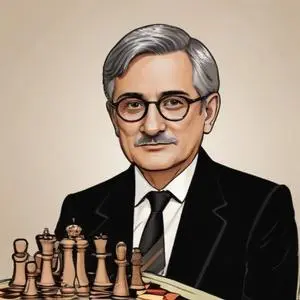
A German polymath who excelled in chess, mathematics, and philosophy, making groundbreaking contributions to these fields, including the development of algebraic geometry and the concept of Hilbert space.
Emanuel Lasker, the German chess player, mathematician, and philosopher, is renowned for being the second World Chess Champion, holding the title for an unprecedented 27 years from 1894 to 1921. This remarkable feat not only solidified his position as one of the strongest players in history but also showcased his versatility and intellectual prowess.
Born on December 24, 1868, in Berlinchen, Neumark (now Barlinek, Poland), Lasker's introduction to chess came at the age of eleven, courtesy of his brother Berthold, a skilled player in his own right. This early start laid the foundation for Lasker's eventual dominance of the game.
Lasker's exceptional talent and dedication led him to defeat the reigning World Chess Champion, Wilhelm Steinitz, in 1894, assuming the title himself. He went on to successfully defend his title for nearly three decades, earning him the nickname "The Pride of German Chess."
Parallel to his chess career, Lasker made significant contributions to mathematics, particularly in the field of commutative algebra. He is credited with proving the primary decomposition of the ideals of polynomial rings, a feat that has had a lasting impact on the discipline.
Lasker's philosophical writings, although not as widely recognized, explored the intersections of logic, ethics, and aesthetics. His drama, co-written with another author, remains an interesting aside in his diverse portfolio of accomplishments.
Lasker's fascination with games extended beyond chess. He was an accomplished contract bridge player and wrote about the game, as well as Go and his own invention, Lasca. His work on card games presented a problem that remains notable in mathematical analysis to this day.
Lasker's influence on modern chess is undeniable, with many considering him one of the strongest players in history. His flexible approach to the game, which often mystified his contemporaries, has been reevaluated and recognized as ahead of its time.
Lasker's life was marked by significant personal milestones, including his relocation to Berlin at the age of eleven to study mathematics. He went on to live in various countries, including the United States, where he spent the final years of his life.
Emanuel Lasker's multifaceted legacy continues to inspire and intrigue scholars, chess enthusiasts, and mathematicians alike, cementing his place as one of the most remarkable minds of the early 20th century.
Lasker's numerous accolades include being honored as a grandmaster by the World Chess Federation (FIDE) in 1950, as well as having a crater on the Moon named after him in 1961.
In conclusion, Emanuel Lasker's life and achievements serve as a testament to the power of human ingenuity, creativity, and determination. His profound impact on chess, mathematics, and philosophy continues to resonate, inspiring future generations to pursue their passions with unwavering dedication.
63 Years Old
A Russian chess grandmaster and writer, renowned for being the world's top-ranked player for most of the 1980s and 1990s, and for his advocacy of democracy and human rights.
83 Years Old
A chess prodigy who became a grandmaster at 15 and won the World Chess Championship in 1972, known for his exceptional skill and rivalry with Boris Spassky.
56 Years Old
A world chess champion, holding the title five times, and known for his creative and attacking playing style. He's a global icon in the chess world, inspiring millions of players.
51 Years Old
A Russian chess grandmaster who dominated the game for over a decade, becoming the undisputed World Chess Champion in 2006. He's renowned for his strategic and positional playing style.
Born in 1901
A Dutch chess grandmaster, mathematician, and author who made significant contributions to chess theory and was a world chess champion from 1935 to 1937. He's also known for his books on chess strategy.
Born in 1892
A Russian chess grandmaster and writer who dominated the game during the early 20th century, holding the World Chess Championship title from 1927 to 1946 and 1948 to 1946.
Born in 1911
A Soviet chess grandmaster and engineer who dominated the game from the 1940s to 1960s, winning six World Chess Championships and developing the first chess-playing computer program.
Born in 1921
A renowned chess grandmaster and seventh World Chess Champion, known for his strategic and positional playing style, which earned him the title of "Chess Philosopher".
