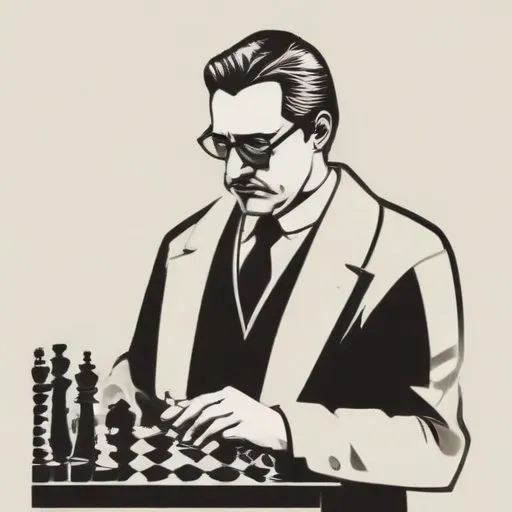
Max Euwe: The Mathematician Who Became a Chess Legend
A World Chess Champion and So Much More
Max Euwe is widely known for being the fifth player to become the World Chess Champion, a title he held from 1935 to 1937. However, his legacy extends far beyond his impressive chess career, as he was also a renowned mathematician, author, and chess administrator.
Early Life and Education
Born on May 20, 1901, in Amsterdam, Euwe studied mathematics at the University of Amsterdam under the founder of intuitionistic logic, L.E.J. Brouwer. He earned his doctorate in 1926 under Roland Weitzenbck and went on to teach mathematics at various institutions, including a girls' Lyceum in Amsterdam.
Chess Career
Euwe's passion for chess began at a young age, with his first tournament at just 10 years old. He went on to win every Dutch chess championship he entered from 1921 to 1952, with his 12 titles still holding the record today. In 1928, he became the world amateur chess champion, and in 1935, he defeated
Alexander Alekhine to become the World Chess Champion.
Mathematical Contributions
Euwe's mathematical expertise led to a significant contribution to the game of chess. In 1929, he published a mathematical analysis of chess from an intuitionistic point of view, using the Thue-Morse sequence to show that the then-official rules did not exclude the possibility of infinite games. This work demonstrated the intersection of mathematics and chess, solidifying Euwe's reputation as a true polymath.
Administrative Roles and Later Life
After World War II, Euwe became interested in computer programming and was appointed professor in this subject at the universities of Rotterdam and Tilburg. He served as President of FIDE, the World Chess Federation, from 1970 to 1978, and retired from Tilburg University in 1971. Euwe passed away on November 26, 1981, leaving behind a legacy that continues to inspire chess players and mathematicians alike.
Awards and Honors
- World Chess Champion (1935-1937)
- World Amateur Chess Champion (1928)
- 12-time Dutch Chess Champion (1921-1952, 1955)
- President of FIDE (1970-1978)
Legacy
Max Euwe's impact on chess is immeasurable, from his contributions to the game as a player and administrator to his mathematical analysis of the game. His legacy extends beyond the chess community, inspiring future generations of mathematicians and polymaths to pursue their passions.
FAQ
What was Max Euwes greatest achievement in chess?
Max Euwes greatest achievement in chess was becoming the World Chess Champion in 1935, defeating Alexander Alekhine in a match to claim the title.
How did Max Euwes mathematical background influence his chess play?
Max Euwes mathematical background influenced his chess play by providing him with a strong analytical and logical approach to the game, which helped him to develop a deep understanding of positional play and strategic planning.
What was Max Euwes most notable contribution to chess theory?
Max Euwes most notable contribution to chess theory was his work on the Euwe Defense, a variation of the Sicilian Defense that bears his name and remains a popular choice among chess players today.
How did Max Euwes involvement in FIDE shape the development of international chess?
Max Euwes involvement in FIDE (Fédération Internationale des Échecs) shaped the development of international chess by promoting the organizations growth and establishing standardized rules and regulations for international competitions.
What was Max Euwes approach to teaching chess?
Max Euwes approach to teaching chess emphasized the importance of logical thinking and analytical skills, encouraging students to develop a deep understanding of the games strategic and tactical principles.