


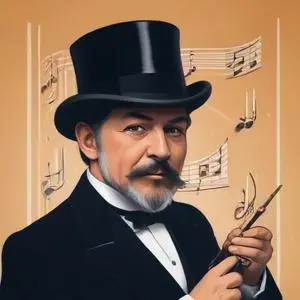
Emmanuel Chabrier is renowned for his captivating orchestral works, particularly España and Joyeuse marche, which have left an indelible mark on the world of classical music. As a French Romantic composer and pianist, Chabrier's unique musical language, free from the shackles of traditional academic training, has influenced a plethora of renowned composers, including Debussy, Ravel, and Stravinsky.
Born on January 18, 1841, in Ambert, France, Chabrier's life was marked by contrasts. His bourgeois family disapproved of a musical career, and he was expected to pursue law. However, his passion for music prevailed, and he immersed himself in the modernist artistic scene of Paris, composing in his spare time.
For nearly two decades, Chabrier balanced his mundane job as a civil servant with his creative pursuits. It wasn't until 1880, at the age of 39, that he finally dedicated himself to music full-time. This marked the beginning of a prolific period, during which he produced some of his most iconic works.
Chabrier's lack of formal training proved to be a blessing in disguise, allowing him to create a distinctive musical language unaffected by established rules. His compositions often blended Wagnerian traits with a distinctly French flair, paving the way for future generations of composers.
Chabrier's circle of friends included some of the most prominent writers and painters of his time. He was particularly close to the renowned painter Édouard Manet, and his personal collection of Impressionist art would later find its way into some of the world's leading museums.
Tragically, Chabrier's life was cut short when he succumbed to a neurological disease, likely caused by syphilis, at the age of 53. Despite his untimely passing, Chabrier's legacy continues to inspire and influence generations of musicians and composers.
Through his letters and compositions, Chabrier has left behind a rich tapestry of insights into his artistic vision and personality. As we delve into the world of this French Romantic composer, we are reminded of the transformative power of creativity and the importance of staying true to one's artistic voice.
Born in 1845
A renowned French pianist, composer, and educator, he is most known for his romantic and impressionistic compositions, particularly his Requiem and nocturnes.
Born in 1822
A Belgian organist and composer who created iconic works that blended Romanticism and Impressionism, leaving a lasting impact on classical music.
Born in 1835
A French Romantic-era mastermind who composed iconic works like "The Carnival of the Animals" and "Danse Macabre", leaving an indelible mark on classical music.
Born in 1803
A French Romantic-era mastermind who composed iconic symphonies, operas, and orchestral works, revolutionizing classical music with his bold, expressive style.
Born in 1811
A virtuosic pianist and composer who revolutionized classical music with his technically demanding and emotionally expressive works, blending Hungarian folk influences with Romantic-era drama.
Born in 1813
A revolutionary composer who transformed opera with his epic, mythological works, creating a new era of musical storytelling. His iconic operas, such as "Der Ring des Nibelungen," continue to captivate audiences worldwide.
Born in 1833
A renowned pianist and composer, he crafted complex, expressive works that blended traditional and innovative techniques, leaving an indelible mark on classical music.
Born in 1840
A renowned Russian composer and educator, he is best known for his iconic and beloved ballets, such as Swan Lake and The Nutcracker, which continue to enchant audiences worldwide.
