


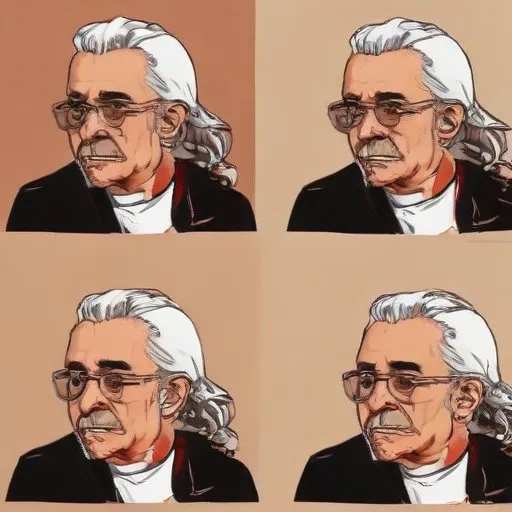
A Nicaraguan priest, poet, and politician who served as Minister of Culture in the Sandinista government, known for blending spirituality and politics in his work. His poetry often explores themes of social justice and liberation.
Ernesto Cardenal, a Nicaraguan Catholic priest, poet, and politician, is best known for his integral role in shaping his country's cultural and political landscape. As a liberation theologian, he founded the primitivist art community in the Solentiname Islands, where he lived for over a decade, and later served as Nicaragua's Minister of Culture from 1979 to 1987.
Born into an upper-class family in Granada, Nicaragua, in 1925, Cardenal's early life was marked by a deep sense of spirituality. He studied literature in Managua and later in Mexico and New York City, where he was exposed to the works of renowned poets like Pablo Antonio Cuadra, his first cousin. In 1950, he traveled through Italy, Spain, and Switzerland, before returning to Nicaragua to participate in the 1954 April Revolution against Anastasio Somoza García's regime.
In 1956, Cardenal had a profound mystical experience that changed the course of his life. He entered the Trappist Monastery of Gethsemani in Kentucky, United States, where he joined poet-priest Thomas Merton, who was the master of novices. Although he left the monastery in 1959 to study theology in Cuernavaca, Mexico, this experience had a lasting impact on his spiritual journey.
In 1965, Cardenal was ordained a Catholic priest in Granada. He went on to found a Christian community in the Solentiname Islands, where he established an artists' colony that attracted visitors like Willarson Brandt, Julio Cortázar, Asilia Guillén, and Aída Margarita. It was during this time that he wrote his famous book, El Evangelio en Solentiname (The Gospel in Solentiname), which became a testament to his unique blend of faith and art.
In 1979, Cardenal became Nicaragua's Minister of Culture, a position he held until 1987. During this time, he worked tirelessly to promote the country's cultural heritage and was recognized for his contributions. However, his political career was not without controversy. In 1984, Pope John Paul II prohibited him from administering the sacraments, a decision that was later reversed by Pope Francis in 2019.
Ernesto Cardenal's life was marked by a deep commitment to his faith, his art, and his country. Through his poetry, his politics, and his community-building initiatives, he inspired generations of Nicaraguans and left an indelible mark on the nation's cultural landscape. Today, he is remembered as a true icon of liberation theology and a testament to the power of faith and creativity to shape a better world.
Born in 1904
A Chilean poet and diplomat who wrote passionate and evocative poetry that explored love, politics, and the human condition, and was awarded the Nobel Prize in Literature in 1971.
99 Years Old
A Colombian journalist and author who crafted magical realism, a literary style that blends fantasy and reality, and won the Nobel Prize in Literature in 1982. His works are known for their vivid storytelling and exploration of human experience.
Born in 1914
A pioneering figure in magical realism, blending fantastical elements with everyday life in his novels and short stories, exploring the human condition and social commentary.
90 Years Old
A Nobel Prize-winning writer and politician who explored the complexities of Peruvian society through his novels and essays, and later ran for president. His works often blended politics, history, and fiction.
Born in 1914
A Mexican poet and diplomat who won the Nobel Prize in Literature in 1990 for his work that explores the intersection of poetry, philosophy, and politics. He's known for his lyrical and introspective style that explores the human condition.
Born in 1908
Chile's first democratically elected Marxist president, who implemented radical socialist reforms and nationalized key industries, but was overthrown in a CIA-backed coup.
Born in 1926
The Cuban revolutionary who led the country from 1959 to 2008, implementing socialist policies and defying US opposition, becoming an iconic figure in modern history.
72 Years Old
The charismatic leader who transformed Venezuela through socialist reforms and anti-imperialist rhetoric, leaving a lasting impact on the country's politics and economy.
