


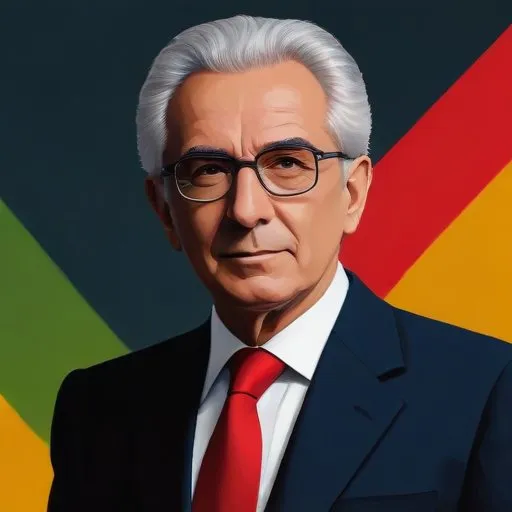
Led Mexico's government from 1994 to 2000, implementing economic reforms and navigating the country's financial crisis. He's also known for his work on international development and climate change initiatives.
Ernesto Zedillo, a prominent Mexican economist and politician, is known for serving as the 61st president of Mexico from 1994 to 2000, and for his influential views on globalization and its impact on developing nations. During his presidency, he navigated the country through one of its worst economic crises, implemented significant political reforms, and paved the way for a new era in Mexican politics.
Born on December 27, 1951, in Mexico City, Ernesto Zedillo Ponce de León pursued his academic interests in economics, earning a degree from the National Polytechnic Institute and later a Ph.D. from Yale University. His early career saw him working in various roles, including as an economist at the Central Bank of Mexico and as a professor at the National Autonomous University of Mexico.
Zedillo's political career took off when he became a member of the Institutional Revolutionary Party (PRI), the dominant political party in Mexico at the time. He served as Secretary of Planning and Budget under President Carlos Salinas de Gortari and later as Minister of Planning and Budget. In 1994, he was elected as the president of Mexico, becoming the last of the uninterrupted 71-year line of PRI presidents.
During his presidency, Zedillo faced numerous challenges, including a severe economic crisis that began just weeks after taking office. He implemented several reforms aimed at addressing the crisis, including the controversial implementation of Fobaproa to rescue the national banking system. He also introduced political reforms, such as allowing residents of the Federal District (Mexico City) to elect their own mayor, and privatized national railways.
Although Zedillo's presidency was marked by controversy, including the Aguas Blancas and Acteal massacres, he is credited with overseeing a relative economic recovery and paving the way for a new era in Mexican politics. His admission of the PRI's defeat in the 2000 general election and his peaceful handing of power to his successor, Vicente Fox, improved his image in the final months of his administration. He left office with an approval rating of 60%.
Since the end of his term as president, Zedillo has been a leading voice on globalization, particularly its impact on relations between developed and developing nations. He has served as the director of the Center for the Study of Globalization at Yale University and has written extensively on the topic. His work has focused on promoting international cooperation and addressing the challenges posed by globalization to developing countries.
Zedillo has received numerous awards and honors for his contributions to politics, economics, and education. These include the Belisario Domínguez Medal, the highest honor awarded by the Mexican Senate, and the Prince of Asturias Award for International Cooperation.
Zedillo is married to Nilda Patricia Velasco, and they have three children together. He is known for his philanthropic work, particularly in the area of education. He has served on the boards of several organizations, including the Bill and Melinda Gates Foundation and the World Wildlife Fund.
In conclusion, Ernesto Zedillo's legacy as a leader in Mexican politics and a prominent voice on globalization continues to shape the country's economic and political landscape. His commitment to promoting international cooperation and addressing the challenges posed by globalization has made him a respected figure in both Mexico and the global community.
64 Years Old
The 56th President of Mexico, a lawyer-turned-politician who served from 2006 to 2012, is known for his efforts to combat drug cartels and reform the country's energy sector.
84 Years Old
The first president to end the Institutional Revolutionary Party's 71-year rule, known for his efforts to reform Mexico's economy and politics. He's a vocal critic of Donald Trump's policies towards Mexico.
91 Years Old
The 52nd President of Mexico, a lawyer and politician who implemented economic reforms and democratization, known for stabilizing the country's economy and introducing neoliberal policies.
Born in 1922
The 50th President of Mexico, a scholar and politician, served from 1970 to 1976 and is infamous for his role in the 1968 Tlatelolco massacre and subsequent human rights abuses. He later became a prominent figure in international politics and academia.
Born in 1920
A Mexican lawyer and politician who served as the 31st President of Mexico, known for his nationalistic policies and efforts to reduce Mexico's dependence on foreign oil. He's also infamous for his corrupt and authoritarian regime.
Born in 1890
A Mexican general and politician who served as President of Mexico from 1952 to 1958, known for his efforts to modernize the country and promote social welfare. He implemented various reforms, including the establishment of a national healthcare system.
Born in 1895
A Mexican revolutionary general who served as president, implementing significant land reforms and nationalizing the oil industry, and father of a prominent politician.
