


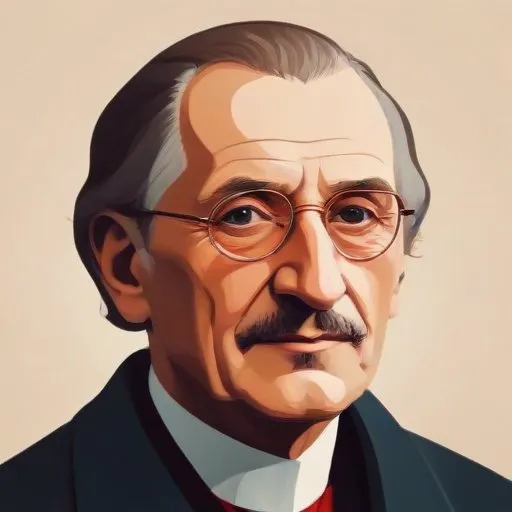
A German philosopher and academic who developed a philosophical system that emphasized the role of individual experience and perception, and is known for his critiques of metaphysics and epistemology.
Ernst Laas, born on June 16, 1837, in Frstenwalde, Brandenburg, Prussia, was a renowned gymnasium teacher, philosopher, and education reformer who made significant contributions to the fields of positivism and pedagogy. He is best known for his chairmanship of philosophy and pedagogy at the University of Strasbourg and his influential works on the history of philosophy and sensualism-based philosophies.
Laas grew up in economically challenged circumstances, facing numerous hardships during his childhood, especially during the difficult years of 1846 and 1847 and the subsequent revolutionary period. Despite these challenges, he was determined to make a difference in his life, attributing his success to his personal energy and hard work.
Thanks to the support of his school principal, Rector Gaedke, and General von Massow, who admired his father's loyalty to the crown, Laas was able to attend the prestigious Joachimsthal Gymnasium in Berlin, where he later became a boarding student.
Laas' work focused on the history of philosophy, particularly on sensualism-based philosophies. His research and writings provided valuable insights into the subject, making him a prominent figure in the positivist movement.
His philosophical contributions centered around the idea that knowledge should be based on empirical evidence and observation, rather than speculation or abstract theories. This approach earned him recognition as a leading positivist thinker of his time.
Laas' most notable works include his writings on the history of philosophy, which provided a comprehensive understanding of the subject. His research and publications earned him the chairmanship of philosophy and pedagogy at the University of Strasbourg, a prestigious position that solidified his reputation as a leading scholar.
Some of his notable works include:
Laas' life was marked by his determination to succeed against all odds. From collecting firewood as a young boy to support his family to becoming a renowned philosopher, his journey was a testament to his hard work and perseverance.
He remained humble and true to his roots, never forgetting his difficult childhood and the struggles his family faced. This humility earned him the respect and admiration of his peers and students.
Ernst Laas' contributions to positivism and education reform have had a lasting impact on modern society. His emphasis on empirical evidence and observation laid the foundation for future philosophical and scientific advancements.
As an education reformer, Laas advocated for a more practical and student-centered approach to learning, which has influenced educational systems around the world.
Today, Laas is remembered as a pioneering figure in the fields of positivism and education, leaving behind a legacy of scholarship, dedication, and perseverance.
Born in 1724
Developed influential philosophical frameworks, such as the Critique of Pure Reason, that shaped modern Western thought on ethics, morality, and human understanding.
Born in 1770
A German philosopher and academic who developed a comprehensive and systematic philosophy that emphasized the unity of all things and the dialectical process of thesis, antithesis, and synthesis. His ideas have had a profound impact on modern thought, influencing fields such as philosophy, politics, and art.
Born in 1788
A pessimistic philosopher who wrote about the human condition, emphasizing the struggles and sufferings of life, and is famous for his concept of the "will to life".
Born in 1632
A 17th-century philosopher and scholar who developed a comprehensive philosophical system that emphasizes God, nature, and human freedom, influencing modern thought on ethics, politics, and religion.
Born in 1646
Developed calculus independently of Isaac Newton, and made major contributions to the fields of philosophy, politics, and history.
Born in 1712
A pioneering thinker who shaped modern democracy and education with his ideas on social contracts, general will, and the importance of early childhood education. His writings influenced the French Revolution and modern political thought.
Born in 1632
A 17th-century thinker who laid the groundwork for modern democracy, arguing that governments derive their power from the people and that individuals have inherent rights to life, liberty, and property.
