


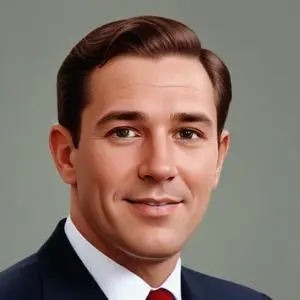
A crusading politician who took on organized crime and monopolies, known for his televised Senate hearings that exposed corruption and led to major reforms.
Estes Kefauver, a renowned American politician from Tennessee, is best known for his tireless crusade against organized crime in the early 1950s. His groundbreaking investigations and hearings exposed the dark underbelly of American society, shedding light on the nefarious activities of notorious gangsters and their corrupt connections to politicians and law enforcement officials.
Born on July 26, 1903, in Madisonville, Tennessee, Kefauver was instilled with a strong sense of civic duty from an early age. His father, Robert Cooke Kefauver, served as the mayor of their hometown, introducing Estes to the world of politics and public service. After graduating from the University of Tennessee in 1924, Kefauver earned his law degree from Yale Law School in 1927, cum laude.
Kefauver's foray into politics began in 1935, when he was elected to the Tennessee State Senate. His dedication to the people of Tennessee and his commitment to fighting corruption earned him a seat in the U.S. House of Representatives in 1939. Throughout the 1940s, he served with distinction, eventually winning a seat in the U.S. Senate in 1949, where he would remain until his untimely death in 1963.
In 1950, Kefauver chaired the Senate Special Committee to Investigate Organized Crime in Interstate Commerce, dubbed the "Kefauver Committee." Over 15 months, the committee conducted exhaustive hearings, exposing the vast networks of organized crime that had infiltrated American society. The committee's findings led to widespread outrage, prompting calls for reform and ultimately contributing to the downfall of notorious figures like Meyer Lansky and Frank Costello.
In 1952 and 1956, Kefauver sought the Democratic Party's nomination for President, although he ultimately lost to Adlai Stevenson. However, in 1956, Stevenson selected Kefauver as his running mate, a remarkable testament to Kefauver's reputation and influence within the Democratic Party.
Estes Kefauver's unwavering commitment to justice and his unrelenting pursuit of organized crime have left an indelible mark on American history. His pioneering work paved the way for future generations of lawmakers, law enforcement officials, and crusaders against corruption. Through his tireless efforts, Kefauver demonstrated the enduring power of public service and the importance of standing up against forces that seek to undermine the fabric of our society.
Born in 1917
The 35th President of the United States was a charismatic leader who navigated the country through the Cuban Missile Crisis and advocated for civil rights, leaving a lasting legacy in American politics.
Born in 1908
The 36th President of the United States, a skilled politician and leader, played a crucial role in passing landmark civil rights legislation, including the Civil Rights Act and Voting Rights Act.
Born in 1913
The 37th President of the United States, a polarizing figure who led the country through significant domestic and foreign policy changes, infamous for his involvement in the Watergate scandal.
Born in 1911
The 38th Vice President of the United States was a prominent liberal politician and journalist who played a key role in shaping the country's civil rights policies. He's most known for his strong support of the Civil Rights Act of 1964.
Born in 1835
The 23rd Vice President of the United States was a skilled lawyer and politician who served under President Grover Cleveland from 1893 to 1897, known for his strong oratory skills and progressive policies. He played a key role in shaping the country's foreign policy during his tenure.
Born in 1890
Led the Allied forces to victory in World War II and later served as President, maintaining peace and prosperity during the Cold War era. He's known for his strategic leadership and diplomatic skills.
Born in 1884
The 33rd President of the United States, a strong leader who made tough decisions, including dropping atomic bombs on Japan and establishing the Marshall Plan to rebuild Europe after WWII.
Born in 1882
Led the United States through the Great Depression and World War II, implementing a series of reforms known as the New Deal and helping to establish the country as a global superpower.
