


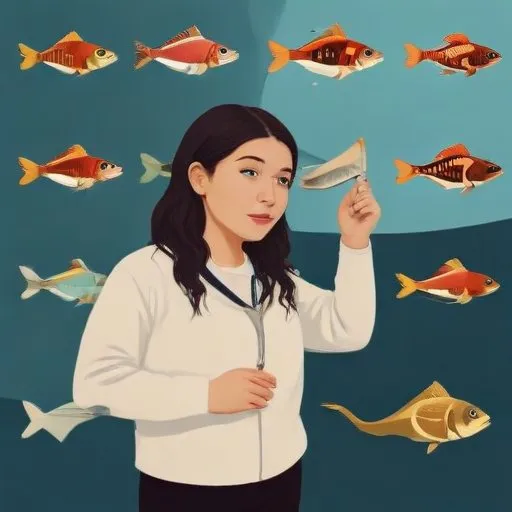
A renowned British ichthyologist who discovered and described numerous fish species, earning her a lasting legacy in the scientific community. Her contributions have significantly advanced our understanding of marine life.
Ethelwynn Trewavas was a renowned ichthyologist at the British Museum of Natural History, known for her groundbreaking work on the families Cichlidae and Sciaenidae. Her dedication to the field spanned nearly five decades, earning her international recognition as an authority on diverse groups of fishes.
Trewavas was born on November 5, 1900, and received her bachelor's degree and Board of Education Certificate in Teaching from Reading University in 1921. She began her career as a teacher and later worked as a part-time demonstrator at the King's College of Household and Social Science, where she devoted most of her time to research.
Trewavas' association with the Freshwater Biological Association led her to work under the guidance of Dr. Nellie B. Eales. Her collaboration with Charles Tate Regan, another prominent ichthyologist, marked the beginning of a long and fruitful partnership. She was employed by Regan as his assistant and later joined the British Museum of Natural History as an Assistant Keeper in 1935. Her hard work and dedication earned her the position of Deputy Keeper of Zoology in 1958, a role she held until her retirement in 1961.
Trewavas' extensive research and publications on various fish groups have left an indelible mark on the field of ichthyology. Her work on African Rift lake cichlids is particularly notable, and she is credited with describing numerous species within this group. Her research methods were innovative for her time, combining laboratory study with extensive field trips and interviews with local people to gain insight into the behavior, form, and food potential of fishes.
Trewavas' legacy extends beyond her own research. She mentored prominent researcher Ad Konings, who has continued her work on African cichlids. Her influence is also evident in the currently named genus categories of Lake Malawi mbuna, with two attributed to Regan and six to Trewavas. Additionally, of the Haplochromis sensu lato in the lake, five were described by Regan and twenty-seven by Trewavas, either individually or in partnership with David Eccles.
Despite her remarkable achievements, Trewavas faced challenges later in life, including failing eyesight. Her dedication to her craft was unwavering, as she gifted her stereo microscope to Ad Konings, ensuring that her work would continue.
Ethelwynn Trewavas passed away on August 16, 1993, leaving behind a rich legacy in the field of ichthyology. Her pioneering spirit, tireless efforts, and contributions to our understanding of the natural world continue to inspire future generations of scientists and researchers.
Born in 1809
Developed the theory of evolution through natural selection, revolutionizing our understanding of life on Earth. This groundbreaking idea transformed the fields of biology, ecology, and beyond.
Born in 1823
A pioneering naturalist who discovered evolution through natural selection, independently of Charles Darwin, and contributed significantly to the field of biogeography.
Born in 1825
A British explorer who traveled to the Amazon rainforest and discovered over 8,000 species, including butterflies, beetles, and birds, and is known for his theory of mimicry in nature.
Born in 1834
A German biologist, physician, and philosopher who coined the term "ecology" and made significant contributions to the field of evolutionary biology, including the recapitulation theory.
Born in 1922
Pioneering ichthyologist who explored the ocean's depths, discovering new species and debunking shark myths, earning the nickname "Shark Lady."
Born in 1910
A pioneering oceanographer who co-developed the aqua-lung, allowing humans to explore the underwater world, and documented his discoveries through captivating films and books.
Born in 1907
Pioneering biologist and environmentalist who exposed the dangers of pesticides and inspired the modern environmental movement through her groundbreaking book "Silent Spring".
Born in 1707
Developed the system of binomial nomenclature, which is still used today to classify and name living organisms. This system has had a profound impact on the fields of biology, ecology, and conservation.
