


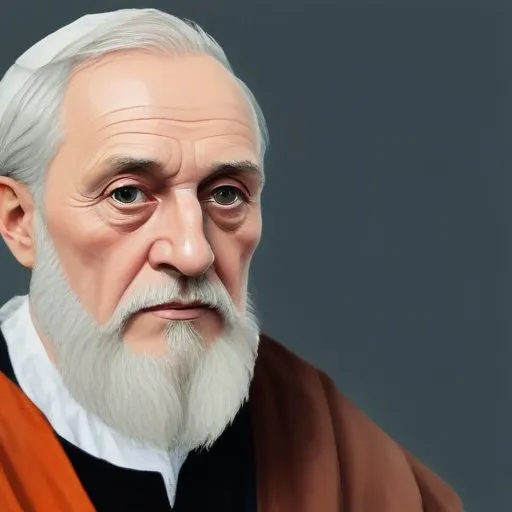
A 17th-century German poet and theologian who wrote influential works on Catholic theology and poetry, earning him recognition in literary and religious circles.
Eusebius Amort was a German Roman Catholic theologian, philosopher, and polymath, renowned for his vast contributions to various fields, including theology, philosophy, astronomy, and mysticism. He is best known for his comprehensive and influential works on Catholic doctrine, indulgences, and mystical experiences, which continue to inspire and educate scholars to this day.
Born on November 15, 1692, in Bibermühle, near Tolz, in Upper Bavaria, Amort was drawn to intellectual pursuits from an early age. He studied at Munich, where he joined the Canons Regular at Polling, and was ordained in 1717. It was during this period that he began teaching theology and philosophy, laying the foundations for his future scholarly endeavors.
In 1720, Amort, along with two other Augustinian fathers, Gelasius Hieber and Agnellus Kandler, founded the Parnassus Boicus society, a learned association dedicated to promoting the arts and sciences. Although the initial plans faltered, the society's journal, published in 1722, showcased Amort's passion for disseminating knowledge and fostering intellectual discourse. This pioneering effort eventually inspired the creation of the Academy of Sciences of Munich, a testament to Amort's vision and dedication to the advancement of learning.
In 1733, Amort traveled to Rome, where he served as theologian to Cardinal Niccolò Maria Lercari. This experience broadened his intellectual horizon and deepened his understanding of Catholic doctrine. Upon his return to Polling in 1735, Amort dedicated himself to revitalizing education in Bavaria, pouring his energies into writing and teaching. His prolific output, spanning multiple disciplines, earned him the reputation of being the most learned man of his age.
Eusebius Amort's extraordinary intellect, coupled with his boundless curiosity and passion for learning, has left an indelible mark on the world of theology, philosophy, and astronomy. His writings, characterized by their erudition and depth, continue to inspire scholars and researchers, ensuring his legacy as one of the most distinguished thinkers of the 18th century.
Born in 1483
A German monk and priest who sparked the Protestant Reformation, challenging Catholic Church authority and shaping Western Christianity. He's famous for nailing 95 theses to a church door, sparking a religious revolution.
Born in 1685
A master of Baroque music, he composed over 1,000 works, including orchestral suites, cantatas, and passions, that still inspire and influence musicians today. His innovative use of counterpoint and harmony raised the bar for classical music.
Born in 1759
A renowned poet and playwright who crafted influential works that explored the human condition, morality, and the struggle for freedom, leaving a lasting impact on German literature.
Born in 1749
A German literary giant who penned iconic works like "Faust" and "The Sorrows of Young Werther", shaping the Romantic movement and influencing countless writers.
Born in 1724
Developed influential philosophical frameworks, such as the Critique of Pure Reason, that shaped modern Western thought on ethics, morality, and human understanding.
Born in 1770
A German philosopher and academic who developed a comprehensive and systematic philosophy that emphasized the unity of all things and the dialectical process of thesis, antithesis, and synthesis. His ideas have had a profound impact on modern thought, influencing fields such as philosophy, politics, and art.
Born in 1788
A pessimistic philosopher who wrote about the human condition, emphasizing the struggles and sufferings of life, and is famous for his concept of the "will to life".
