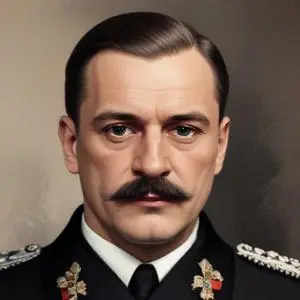
Felix Steiner: The Notorious SS Commander of World War II
Early Life and Military Career
Felix Steiner was a German SS commander who made a name for himself during World War II as a formidable military leader. Born on May 23, 1896, in Stalluponen, East Prussia (now Nesterov, Russia), Steiner joined the German Army in 1914 and served during World War I, earning the Iron Cross for his bravery.
Rise to Prominence in the Waffen-SS
After the war, Steiner joined the Waffen-SS, the combat branch of the SS, and quickly rose through the ranks. Alongside Paul Hausser, he played a significant role in transforming the Waffen-SS into a formidable fighting force, comprising volunteers and conscripts from occupied and unoccupied territories. Steiner's exceptional leadership skills earned him the prestigious Knights Cross of the Iron Cross with Oak Leaves and Swords, one of the highest military honors in Nazi Germany.
In 1940, Steiner was handpicked by Heinrich Himmler to oversee the creation and command of the SS Division Wiking, a unit comprising Danish, Norwegian, and Dutch volunteers. Later, in 1943, Steiner was promoted to command the III SS Panzer Corps, a key armored formation in the German military.
The Battle for Berlin and the Fall of Germany
As the war turned against Germany, Steiner played a crucial role in the Battle for Berlin. On January 28, 1945, he was placed in command of the 11th SS Panzer Army, part of the newly formed Army Group Vistula, tasked with defending Berlin against the Soviet armies advancing from the Vistula River. Despite his valiant efforts, Steiner's forces were vastly outnumbered, and he made it clear to Adolf Hitler during the daily situation conference on April 22, 1945, that a counterattack was impossible.
Post-War and Later Life
Following Germany's capitulation, Steiner was imprisoned and investigated for war crimes. Although he faced charges at the Nuremberg Trials, they were eventually dropped, and he was released in 1948. In 1953, Steiner was recruited by the U.S. Central Intelligence Agency to found the Gesellschaft für Wehrkunde (Society for Defense Studies), a think tank comprising former German military officers, aimed at promoting the rearmament of West Germany.
Steiner's legacy remains shrouded in controversy, with some hailing him as a brilliant military strategist and others condemning his role in the atrocities committed by the Waffen-SS during World War II. As a founding member of HIAG, a lobby group of former Waffen-SS personnel, Steiner's later life was marked by his efforts to rehabilitate the image of the Waffen-SS and promote the interests of former German military officers.
- Steiner was awarded the Knights Cross of the Iron Cross with Oak Leaves and Swords, one of the highest military honors in Nazi Germany.
- He commanded the SS Division Wiking, a unit comprising Danish, Norwegian, and Dutch volunteers.
- Steiner played a crucial role in the Battle for Berlin, defending the city against the Soviet armies.
- He was recruited by the U.S. Central Intelligence Agency to promote the rearmament of West Germany.
- Steiner was a founding member of HIAG, a lobby group of former Waffen-SS personnel.
FAQ
What was Felix Steiners role in the Waffen-SS?
Felix Steiner was a high-ranking officer in the Waffen-SS, a branch of the German military during World War II. He held the rank of SS-Obergruppenführer.
What were Felix Steiners experiences during World War II?
Felix Steiner fought on the Eastern Front during World War II and was involved in several key battles, including the Battle of Berlin.
What was Felix Steiners relationship like with Adolf Hitler?
Felix Steiner had a complex and often contentious relationship with Adolf Hitler, whom he both admired and criticized.
What was Felix Steiners legacy in the Waffen-SS?
Felix Steiners legacy is that of a skilled and dedicated military leader who played a significant role in the Waffen-SS during World War II.
How did Felix Steiners experiences in World War I shape his perspectives on war and politics?
Felix Steiners experiences in World War I had a profound impact on his perspectives on war and politics, leading him to become increasingly disillusioned with the Nazi regime.