


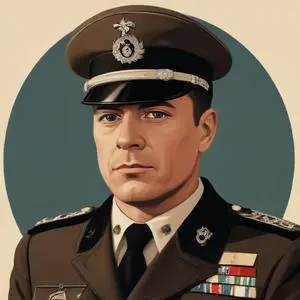
A notorious Waffen-SS commander, infamous for his role in the Malmedy massacre during the Battle of the Bulge, and other war crimes.
Joachim Peiper, a German Schutzstaffel (SS) officer, is infamous for his role in war crimes during World War II, particularly as the commander of Kampfgruppe Peiper, a battle group notorious for committing atrocities against civilians and prisoners of war. His brutal actions earned him the nickname "Jochen der Nacht" or "Jochen of the Night."
Peiper was born on January 30, 1915, in Berlin, Germany, to a middle-class family from Silesia. His father, Woldemar Peiper, was an officer in the Imperial German Army who fought in the 1904 campaign in German South West Africa. Peiper's upbringing and family background instilled in him a strong sense of nationalism and militarism.
Peiper joined the SS in 1933, quickly rising through the ranks due to his exceptional organizational skills and loyalty to the Nazi regime. He became the personal adjutant to Heinrich Himmler, the leader of the SS, and played a significant role in implementing the Holocaust and ethnic cleansing policies in Eastern Europe.
As a tank commander in the Waffen-SS, Peiper fought in several key battles, including the Third Battle of Kharkov and the Battle of the Bulge. His unit, Kampfgruppe Peiper, was responsible for numerous war crimes, including the Malmedy massacre, where over 70 American prisoners of war were brutally murdered.
After the war, Peiper was imprisoned for his war crimes, but he was released in 1957. He went on to work for the Porsche and Volkswagen automobile companies before moving to France, where he worked as a freelance translator. Despite his post-war attempts to distance himself from his Nazi past, Peiper remained active in the social network of ex-SS men, centered around the right-wing organization HIAG (Mutual Aid Association of Former Members of the Waffen-SS).
In 1976, Peiper's home in France was set on fire by communist arsonists who had discovered his identity. Peiper died from asphyxiation in the blaze, which many saw as a form of poetic justice for his role in perpetuating Nazi atrocities.
Peiper's beliefs and actions embodied the Nazi ideology, which emphasized the superiority of the Aryan race and the need for ethnic cleansing. His actions, particularly during the war, reflected a complete disregard for human life and a willingness to carry out atrocities in the name of nationalism and militarism.
Peiper's actions and beliefs are often compared to those of other notorious Nazi officials, such as Adolf Eichmann and Ernst Kaltenbrunner. While all three were instrumental in perpetuating the Holocaust and war crimes, Peiper's role as a field commander and his direct involvement in atrocities set him apart from his contemporaries.
Joachim Peiper's life and actions serve as a somber reminder of the atrocities committed during World War II. His legacy is one of brutality, nationalism, and militarism, and his actions continue to be studied by historians and scholars today.
In conclusion, Joachim Peiper's life was marked by controversy, brutality, and a complete disregard for human life. His actions, both during and after the war, continue to be felt today, serving as a reminder of the dangers of unchecked nationalism and militarism.
Born in 1900
Leading the SS and Gestapo, he oversaw the Nazi regime's brutal security apparatus and implemented the "Final Solution," orchestrating the genocide of six million Jews during World War II.
Born in 1889
The dictator of Nazi Germany, responsible for the genocide of six million Jews and millions of other people during World War II, and infamous for his extreme nationalist and anti-Semitic ideology.
Born in 1897
A mastermind of Nazi propaganda, he crafted a persuasive narrative that fueled the Third Reich's rise to power, leaving a lasting impact on the world.
Born in 1893
A high-ranking Nazi official, he was a decorated World War I fighter pilot and later became a prominent politician, serving as Minister President of Prussia. He's infamous for his role in the Nazi regime and war crimes trials.
Born in 1903
Austrian-German lawyer and general who served as the highest-ranking leader of the Nazi police forces, responsible for overseeing the Gestapo, SS, and concentration camps during World War II. He was a key figure in the Holocaust and other atrocities committed by the Nazi regime.
Born in 1891
A German naval commander who led the U-boat fleet during World War II and briefly served as President of Germany after Hitler's death, known for his role in the war and its aftermath.
Born in 1876
A German naval leader who played a key role in the Kriegsmarine during World War II, overseeing the German U-boat fleet and naval operations. He was a close advisor to Adolf Hitler and implemented the German naval strategy during the war.
Born in 1891
A skilled and highly decorated military leader, known for his tactical genius and defensive strategies during World War II, earning him the respect of both his allies and enemies.
