


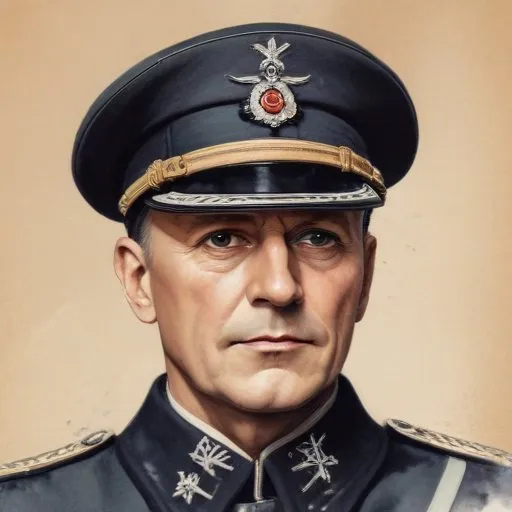
A ruthless and efficient administrator who oversaw the creation and operation of Nazi concentration camps during World War II, responsible for the deaths of millions of people.
Theodor Eicke was a senior SS functionary and Waffen SS divisional commander during the Nazi era, notorious for his role in developing and expanding the Nazi concentration camp system. He was one of the key figures responsible for the brutal treatment of prisoners and the atrocities committed within these camps.
Theodor Eicke was born on 17 October 1892, in Hampont, Alsace-Lorraine, to a lower middle-class family. His father, a station master, was described as a German patriot. Eicke was an underachiever in school, dropping out at the age of 17 before graduation. Instead, he joined the Bavarian Army 23rd Bavarian Infantry Regiment at Landau as a volunteer.
Eicke participated in the Lorraine campaign, fighting at both the First Battle of Ypres in 1914 and the Second Battle of Ypres in 1915, and was with the 2nd Bavarian Foot Artillery Regiment at the Battle of Verdun in 1916. He served as a clerk, an assistant paymaster, and a frontline infantryman, and for his bravery during the war was awarded the Iron Cross Second Class.
After the war, Eicke became involved with the Nazi Party, rising through the ranks to become a senior SS functionary. In June 1933, he was appointed as the second commandant of the Dachau concentration camp, where he implemented brutal and inhumane treatment of prisoners. Together with his adjutant Michael Lippert, Eicke was one of the executioners of SA Chief Ernst Röhm during the Night of the Long Knives purge of 1934.
In 1934, Eicke became the first Concentration Camps Inspector, expanding and developing the concentration camp system across Germany. His role in this position cemented his reputation as one of the most notorious SS officials of the Nazi era.
In 1939, Eicke became commander of the SS Division Totenkopf of the Waffen SS, leading the division during the Second World War on the Western and Eastern fronts. He was known for his brutal tactics and was feared by his enemies.
Eicke was killed on 26 February 1943, when his plane was shot down during the Third Battle of Kharkov.
Theodor Eicke's role in the development and expansion of the Nazi concentration camp system has left a lasting impact on modern society. His brutal treatment of prisoners and his involvement in the atrocities committed during the Holocaust have made him one of the most notorious figures of the Nazi era.
Eicke's legacy serves as a reminder of the dangers of extremism, hatred, and intolerance. His story is a cautionary tale of the devastating consequences of blindly following a ideology that promotes violence and discrimination.
Theodor Eicke's story is a dark reminder of the horrors of the Nazi regime and the importance of promoting tolerance, understanding, and human rights.
Born in 1900
Leading the SS and Gestapo, he oversaw the Nazi regime's brutal security apparatus and implemented the "Final Solution," orchestrating the genocide of six million Jews during World War II.
Born in 1889
The dictator of Nazi Germany, responsible for the genocide of six million Jews and millions of other people during World War II, and infamous for his extreme nationalist and anti-Semitic ideology.
Born in 1903
Austrian-German lawyer and general who served as the highest-ranking leader of the Nazi police forces, responsible for overseeing the Gestapo, SS, and concentration camps during World War II. He was a key figure in the Holocaust and other atrocities committed by the Nazi regime.
Born in 1904
A high-ranking Nazi official and chief architect of the Holocaust, responsible for implementing the "Final Solution" that led to the murder of six million Jews and millions of others during World War II.
Born in 1894
A German sailor-turned-politician who played a key role in the Nazi regime, particularly in organizing forced labor during World War II. He was later tried and executed for war crimes.
Born in 1893
A German diplomat who served as the Nazi regime's Foreign Minister, orchestrating key alliances and treaties that led to World War II. He was a close associate of Adolf Hitler and played a crucial role in shaping Nazi foreign policy.
Born in 1893
A high-ranking Nazi official, he was a decorated World War I fighter pilot and later became a prominent politician, serving as Minister President of Prussia. He's infamous for his role in the Nazi regime and war crimes trials.
Born in 1894
A high-ranking Nazi official who flew to Scotland on a solo mission to negotiate peace with the UK, but was instead arrested and imprisoned.
