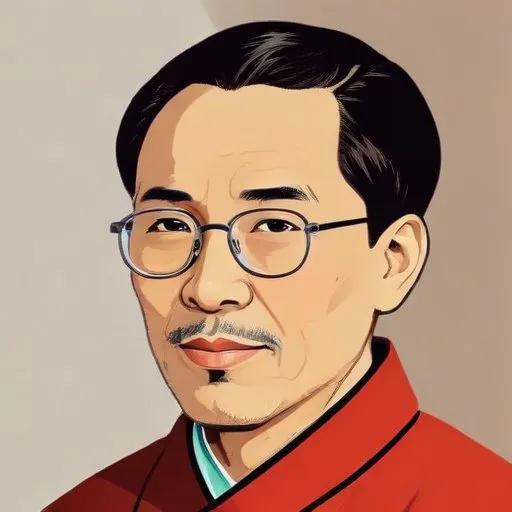
Feng Kang

Feng Kang

Feng Kang was born on September 9th, 1920

Full Name: Feng Kang
Nationality: Chinese
Profession: Mathematician, Physicist
Notable Contributions: Control Theory, Systems Science
Education: Tsinghua University
Born: 1920
Died: 1993
Awards: State Natural Science Award

A renowned mathematician and physicist who made significant contributions to the development of China's nuclear program and was a pioneer in the field of fluid dynamics. He is also known for his work on the two-fluid model of superfluidity.

Written by: Jack Thompson Jack Thompson

Feng Kang: The Pioneer of Computational Mathematics in China

Feng Kang was a renowned Chinese mathematician who made significant contributions to the field of computational mathematics, earning him the title of "the father of Chinese computational mathematics." He is best known for his work on topological groups, Lie groups, and generalized function theory, which paved the way for the development of scientific computing in China.

Early Life and Education

Feng Kang was born on September 9, 1920, in Nanjing, China. He spent his childhood in Suzhou, Jiangsu, and studied at Suzhou High School. In 1939, he was admitted to the Department of Electrical Engineering of the National Central University (now Nanjing University), where he later transferred to the Department of Physics and graduated in 1944.

Career and Contributions

Despite contracting spinal tuberculosis after graduation, Feng continued to learn mathematics on his own and later taught mathematics at Tsinghua University in 1946. He was appointed as an assistant professor at the Institute of Mathematics of the Chinese Academy of Sciences in 1951 and worked at the Steklov Mathematical Institute in Moscow from 1951 to 1953, under the supervision of Professor Lev Pontryagin.

In 1957, he became an associate professor at the Institute of Computer Technology of the Chinese Academy of Sciences, where he began his work on computational mathematics and became the founder and leader of computational mathematics and scientific computing in China. Feng's contributions to the field of mathematics were immense, and he is credited with establishing the Computing Center of the Chinese Academy of Sciences in 1978, which he directed until 1987.

Awards and Honors

In recognition of his outstanding contributions to mathematics, Feng Kang was elected an academician of the Chinese Academy of Sciences in 1980. After his death in 1993, the Chinese Academy of Sciences established the Feng Kang Prize in 1994 to reward young Chinese researchers who make outstanding contributions to computational mathematics.

Legacy

Feng Kang's legacy extends beyond his contributions to mathematics. He inspired generations of Chinese mathematicians and scientists, and his work laid the foundation for the development of scientific computing in China. Today, he is remembered as a pioneer in the field of computational mathematics, and his contributions continue to influence research and innovation in China and beyond.

Personal Milestones and Key Life Events

Quotes and Memorable Sayings

Although Feng Kang's quotes and memorable sayings are not well-documented, his legacy speaks volumes about his dedication to mathematics and his passion for inspiring future generations of mathematicians and scientists.

Timeline
1920
Born in Nanjing, China
Feng Kang was born on November 15th in Nanjing, China. He would go on to become a prominent mathematician and physicist.
1942
Graduated from the University of Nanking
Feng graduated from the University of Nanking with a degree in mathematics and physics.
1957
Elected to the Chinese Academy of Sciences
Feng was elected to the Chinese Academy of Sciences, recognizing his contributions to mathematics and physics.
1980
Became the Director of the Institute of Mathematics
Feng became the Director of the Institute of Mathematics at the Chinese Academy of Sciences.
1993
Passed away at 72
Feng Kang passed away on November 17th at the age of 72, leaving behind a legacy as a respected mathematician and physicist.
Feng Kang

Feng Kang Quiz

Feng Kang's contributions to China's nuclear program were instrumental in the development of which field?

Score: 0/5
FAQ
What is Feng Kang known for in the field of mathematics?
Feng Kang is a renowned Chinese mathematician and physicist known for his contributions to the development of the lattice Boltzmann method, a computational fluid dynamics technique. His work has had significant implications for simulating fluid flows and heat transfer in complex systems.
What are some of Feng Kangs notable contributions to physics?
Feng Kang has made important contributions to the study of statistical physics, particularly in the area of lattice gas automata. His work has shed light on the behavior of complex systems and has applications in fields such as materials science and biophysics.
What is Feng Kangs educational background?
Feng Kang received his undergraduate degree from Tsinghua University in Beijing, China, and went on to earn his Ph.D. in physics from Columbia University in New York City.
Has Feng Kang received any notable awards for his work?
Feng Kang has received numerous awards for his contributions to mathematics and physics, including the National Natural Science Award of China and the Tsinghua University Distinguished Alumni Award.
How does the lattice Boltzmann method work?
The lattice Boltzmann method is a numerical technique used to simulate fluid flows and heat transfer in complex systems. It works by discretizing the Boltzmann equation, which describes the behavior of particles in a fluid, and solving it numerically on a lattice grid.

Related People:

Chen-Ning Yang

Born in 1922

A renowned physicist who made groundbreaking contributions to our understanding of subatomic particles, earning a Nobel Prize for his work on parity non-conservation.

Tsung-Dao Lee

99 Years Old

A Chinese-American physicist and academic who won the Nobel Prize for his work on the parity non-conservation of weak interactions, revolutionizing our understanding of particle physics.

Qian Xuesen

Born in 1911

A Chinese aerodynamicist and academic who made significant contributions to the development of rocket technology and founded the Chinese space program, earning him the title "Father of Chinese Aerospace."

Chien-Shiung Wu

Born in 1912

A pioneering experimental physicist who disproved a fundamental concept in physics, the law of parity, and made groundbreaking contributions to particle physics.