


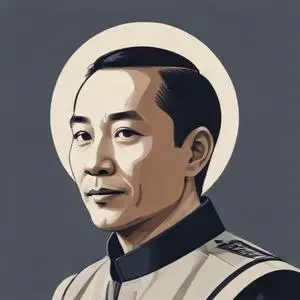
A Chinese aerodynamicist and academic who made significant contributions to the development of rocket technology and founded the Chinese space program, earning him the title "Father of Chinese Aerospace."
Qian Xuesen, also known as Hsueshen Tsien, was a renowned Chinese-American aerospace engineer and cyberneticist who left an indelible mark on the field of aerodynamics and engineering cybernetics. He is celebrated as one of America's leading experts in rockets and high-speed flight theory, with contributions that paved the way for significant advancements in modern aeronautics.
Qian Xuesen was born on December 11, 1911, in Shanghai, China. He pursued his undergraduate degree in mechanical engineering at National Chiao Tung University in Shanghai, graduating in 1934. His academic excellence earned him a spot at the Massachusetts Institute of Technology (MIT), where he earned his master's degree in aeronautical engineering in 1936.
Qian's talent and expertise soon caught the attention of Theodore von Kármán, a renowned Hungarian-American engineer, who invited him to join his group at the California Institute of Technology (Caltech) in 1936. Qian received his doctorate in aeronautics and mathematics from Caltech in 1939 and became an associate professor there in 1943. During his time at Caltech, he co-founded the Jet Propulsion Laboratory (JPL), a pioneering research center that would go on to play a crucial role in America's space exploration endeavors.
In the 1940s, Qian's expertise was sought after by the United States government. He served as an expert consultant with a rank of colonel in 1945 and became an associate professor at MIT in 1946, and later a full professor at MIT in 1947, and then at Caltech in 1949. However, during the Second Red Scare in the 1950s, the United States federal government accused him of communist sympathies, leading to the revocation of his security clearance in 1950. Despite protests from his colleagues and lack of evidence, he was subjected to partial house arrest and government surveillance for five years.
In 1955, Qian was released in exchange for the repatriation of American pilots who had been captured during the Korean War. He left the United States in September 1955, returning to China, where he would go on to make significant contributions to the country's aerospace industry.
Qian Xuesen's contributions to aerodynamics, engineering cybernetics, and rocketry have had a lasting impact on modern society. He is remembered as a pioneer in his field, and his work has paved the way for countless breakthroughs in aerospace engineering. His legacy serves as a testament to the power of innovation, perseverance, and dedication.
"Science and technology are the wings of the nation, and only by strengthening them can we fly higher and farther."
Qian Xuesen's life and work serve as a testament to the power of international collaboration and the pursuit of knowledge. His legacy continues to inspire generations of engineers, scientists, and innovators around the world.
Born in 1881
A pioneer in aerodynamics and fluid dynamics, known for his groundbreaking work on vortex streets and supersonic flight, as well as being a founder of NASA's Jet Propulsion Laboratory.
Born in 1922
A renowned physicist who made groundbreaking contributions to our understanding of subatomic particles, earning a Nobel Prize for his work on parity non-conservation.
99 Years Old
A Chinese-American physicist and academic who won the Nobel Prize for his work on the parity non-conservation of weak interactions, revolutionizing our understanding of particle physics.
Born in 1912
A pioneering experimental physicist who disproved a fundamental concept in physics, the law of parity, and made groundbreaking contributions to particle physics.
Born in 1901
A pioneer in nuclear physics, known for leading the team that developed the first nuclear reactor and playing a crucial role in the development of the atomic bomb.
