


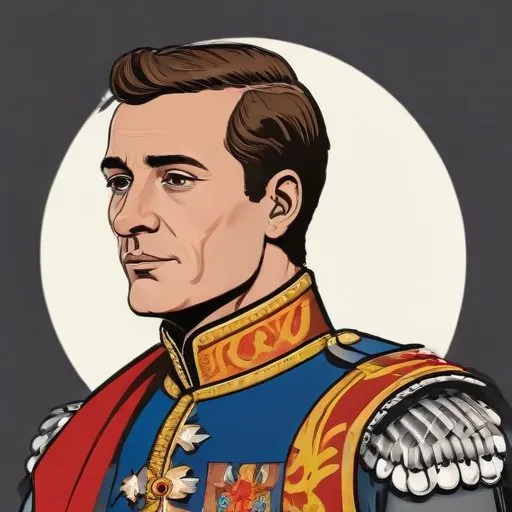
Ferdinand I, also known as the Handsome or the Inconstant, was the King of Portugal from 1367 until his death in 1383. He is remembered for his brief but tumultuous reign, marked by claims to the throne of Galicia and a series of wars with Castile.
Born in Coimbra in 1345, Ferdinand was the second but eldest surviving son of Peter I and his wife, Constanza Manuel. As a member of the Portuguese royal family, Ferdinand was groomed for greatness from a young age. His early life was marked by privilege and luxury, surrounded by the opulence of the royal court.
When Peter of Castile died in 1369, Ferdinand saw an opportunity to expand his kingdom. As great-grandson of Sancho IV, he laid claim to the vacant Castilian throne, sparking a bitter struggle for power. The kings of Aragon and Navarre, as well as John of Gaunt, Duke of Lancaster, also claimed the throne, setting the stage for a series of conflicts.
Ferdinand's claim to the throne was met with resistance, and he found himself at war with Henry of Trastamara, also known as Henry II of Castile. The Castilian Civil War raged on for years, with Ferdinand eventually seeking the mediation of Pope Gregory XI. The treaty that followed, ratified in 1371, included a marriage between Ferdinand and Leonora of Castile.
However, Ferdinand's heart belonged to another - Leonor Telles de Meneses, the wife of one of his own courtiers. He procured a dissolution of her previous marriage and made her his queen, sparking a serious insurrection in Portugal. This scandalous romance would haunt him for the rest of his reign.
Ferdinand's death in 1383 led to the 1383-1385 crisis, also known as the Portuguese interregnum. His lack of legitimate male heirs sparked a succession crisis, plunging Portugal into a period of uncertainty. Despite his tumultuous reign, Ferdinand left an indelible mark on Portuguese history, earning a reputation as a king with a taste for ambition and a penchant for controversy.
Ferdinand I's reign took place during a time of great upheaval in Europe. The Black Death had recently swept through the continent, leaving devastation in its wake. The Hundred Years' War between England and France was ongoing, and the Ottoman Empire was expanding its reach. Against this backdrop, Ferdinand's struggles for power and influence seem almost quaint by comparison.
Ferdinand I's legacy can be seen in the modern-day borders of Portugal and Spain. His claims to the throne of Galicia and Castile may have been unsuccessful, but they laid the groundwork for future conflicts and power struggles. His romantic entanglements and scandals also paved the way for future royal scandals and intrigues.
Ferdinand I may not have been the most successful king, but he certainly left a lasting impact on Portuguese history. His struggles for power and influence, combined with his romantic entanglements, make him a fascinating figure in the annals of history.
Born in 1798
The first emperor of Brazil, who declared the country's independence from Portugal and ruled from 1822 to 1831, is most known for his efforts to modernize and unify Brazil. He's also remembered for his romantic and tumultuous personal life.
41 Years Old
R&B singer-songwriter and producer blending psychedelic rock, funk, and electronic elements to create a distinctive sound, known for his soulful vocals and genre-bending style.
Born in 1321
A 13th-century Italian nobleman who ruled Montferrat and led several military campaigns, including the Fifth Crusade. He's also known for his diplomatic efforts to unite the Latin Empire with the Byzantine Empire.
Born in 1717
The King of Portugal who ruled briefly in 1777, known for his attempts to reform the Portuguese government and military, but was ultimately overthrown by his wife and son.
Born in 1132
Ruling Navarre from 1150 to 1194, he strengthened the kingdom through strategic alliances and military campaigns, earning a reputation as a shrewd and powerful leader.
