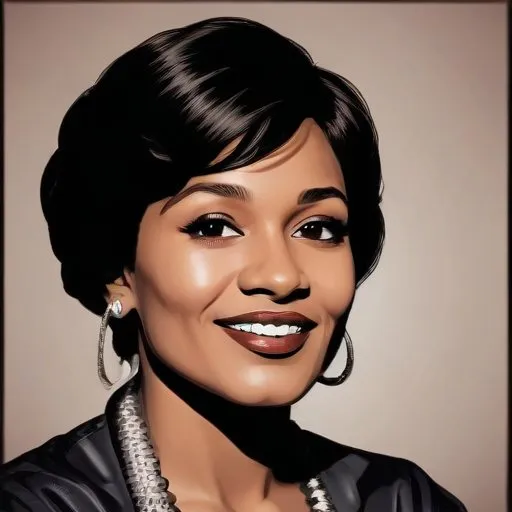
Florence Mills: The "Queen of Happiness"
A Shining Star of the Harlem Renaissance
Florence Mills, born Florence Winfrey, was an American cabaret singer, dancer, and comedian who captivated audiences with her infectious energy and radiant charm, earning her the nickname "Queen of Happiness." With a career spanning over two decades, Mills became a household name, entertaining crowds around the world with her unforgettable performances.
Early Life and Career
Born on January 25, 1896, in Washington, D.C., to formerly enslaved parents Nellie Simon and John Winfrey, Florence began performing at a tender age of six alongside her two older sisters, Olivia and Maude, as the Mills Sisters vaudeville act. After her sisters quit performing, Florence persevered, driven by her passion for show business. She joined the Panama Four, a group that included Ada Smith, Cora Green, and Carolyn Williams, before moving on to the Tennessee Ten, a traveling Black show.
Rise to Stardom
Mills' breakthrough came in 1921 when she met Ulysses Slow Kid Thompson, a dance director and acrobatic dancer, whom she would later marry. This marked the beginning of her journey to stardom, as she landed a role in the Broadway musical Shuffle Along, a production that would go on to define the Harlem Renaissance. The show's success catapulted Mills to international fame, earning her rave reviews in London, Paris, Ostend, Liverpool, and other European cities.
The Plantation Revue and International Acclaim
Lew Leslie, a white promoter, recognized Mills' talent and hired her and Thompson to perform at the Plantation Club, a prestigious nightclub. This led to the creation of The Plantation Revue, a Broadway show that premiered at the Forty-Eighth Street Theatre in 1922. The show featured an impressive lineup of Black artists, including
Paul Robeson, and went on to captivate audiences in London's West End.
Philosophical Contributions and Beliefs
Mills' success was not limited to her performances alone. She was an advocate for racial equality and women's empowerment, using her platform to promote unity and understanding. Her music and comedy sketches often addressed social issues, inspiring her audience to challenge the status quo.
Influence on Modern Society
Florence Mills' legacy extends far beyond her performances. She paved the way for future generations of African American artists, breaking down barriers and challenging racial stereotypes. Her contributions to the Harlem Renaissance helped shape the cultural landscape of the 1920s, earning her a place in history as a trailblazing entertainer.
Tragically Cut Short
Mills' life was tragically cut short when she passed away on November 1, 1927, at the age of 31. Despite her untimely death, her impact on the world of entertainment remains, inspiring new generations of performers and artists.
Fun Facts and Trivia
- Florence Mills was known for her petite stature, standing at just 4 feet 11 inches.
- She was often referred to as "Baby Florence" due to her youthful appearance.
- Mills was a talented composer, writing several original songs for her performances.
Legacy and Rememberance
Florence Mills' legacy continues to inspire and delight audiences today. Her remarkable story serves as a testament to the power of determination, talent, and hard work. As the "Queen of Happiness," Florence Mills left an indelible mark on the world of entertainment, ensuring her memory will be cherished for generations to come.
FAQ
What was Florence Millss contribution to American entertainment?
Florence Mills was an American singer, dancer, and actress who made significant contributions to American entertainment. She is known for her energetic and charismatic performances, which helped to break down racial barriers in the entertainment industry.
What was Florence Millss role in the Harlem Renaissance?
Florence Mills was a key figure in the Harlem Renaissance, a cultural and artistic movement that took place in Harlem in the 1920s and 1930s. Her performances helped to promote African American culture and identity, and she worked alongside other prominent figures of the Harlem Renaissance, such as Langston Hughes and Duke Ellington.
How did Florence Millss experience as an African American woman affect her career?
Florence Millss experience as an African American woman had a significant impact on her career, as she faced racism and discrimination in the entertainment industry. Despite these challenges, she persevered and used her platform to promote African American culture and identity.
What was Florence Millss most famous performance?
Florence Millss most famous performance was her starring role in the 1922 musical Shuffle Along, which was one of the first Broadway shows to feature an African American cast. Her performance in Shuffle Along helped to establish her as a rising star in the entertainment industry.
What is Florence Millss legacy in American entertainment?
Florence Millss legacy in American entertainment is significant, and she is remembered as a pioneering figure in the entertainment industry. Her performances helped to break down racial barriers and promote African American culture and identity, and her influence can be seen in many aspects of modern American entertainment.