


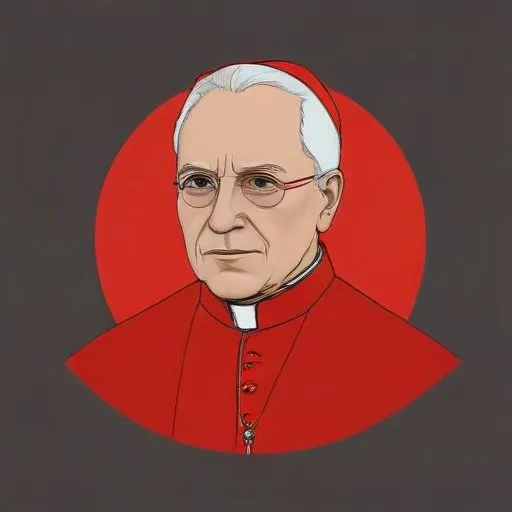
A 17th-century Catholic cardinal who wielded significant influence in the Vatican, known for his cunning politics and lavish spending, earning him the nickname "L'Cardinalino".
Francesco Maidalchini is best known for being the Cardinal-Nephew of Pope Innocent X, a position he held from 1647 until the Pope's death in 1655. During his tenure, Maidalchini played a crucial role in the Roman Catholic Church, despite being criticized for his inexperience and lack of knowledge in worldly affairs.
Francesco Maidalchini was born on April 12, 1631, in Viterbo, Italy, to Andrea Maidalchini and Pacifica Feliziani. His father was the brother of Olimpia Maidalchini, the sister-in-law of Pope Innocent X, which ultimately led to his rise to prominence in the Church.
In 1647, Maidalchini's cousin, Camillo Francesco Maria Pamphili, resigned as Cardinal-Nephew to marry, and Pope Innocent X appointed the 17-year-old Francesco to the position. This decision was met with criticism, as many believed Maidalchini was too young and inexperienced for the role.
As Cardinal-Nephew, Maidalchini was installed as Cardinal-Deacon of Sant'Adriano al Foro. However, he struggled to assert his authority, and many of his responsibilities were delegated to the Secretary of State, Cardinal Giovanni Giacomo Panciroli. Maidalchini's position was further weakened by the fact that the Pope's sisters and other members of the Pamphilj family resented his close association with the pontiff.
Maidalchini received the title of Canon of St. Peter's Basilica in Rome and was named commendatory abbot of St. Martin and St. Gaudentius of Rimini and San Pancrazio outside the walls of Rome. He also received the title of Cardinal-Deacon of Sant'Adriano al Foro.
Maidalchini's tenure as Cardinal-Nephew took place during a tumultuous period in the Roman Catholic Church, marked by power struggles and intrigue. Despite his controversies, Maidalchini played a significant role in the Church's decision-making process, and his legacy continues to be felt to this day.
Little is known about Maidalchini's personal beliefs and philosophical contributions, as his writings and teachings have been largely overshadowed by his role as Cardinal-Nephew. However, it is clear that he was deeply committed to the Roman Catholic Church and worked to advance its interests during his time in power.
Giorlamo Gigli wrote that Maidalchini was forced to reside with his paternal aunt, Olimpia, at the Palazzo Pamphili in Piazza Navona, rather than in his own residence. This arrangement was likely a result of the Pope's desire to keep a close eye on his nephew, as well as to limit his influence.
Maidalchini's legacy continues to be felt in the Roman Catholic Church, where the position of Cardinal-Nephew remains an important one. His experiences also serve as a reminder of the complexities and intrigue that have often characterized the Church's inner workings.
Despite his controversies, Francesco Maidalchini remains an important figure in the history of the Roman Catholic Church, and his legacy continues to fascinate and intrigue scholars and historians to this day.
Born in 1611
Led the Catholic Church during a tumultuous period, reforming the Church's finances and combating corruption, while also opposing the French monarch's attempts to exert control over the Church.
Born in 1431
Ruthless and cunning, this Pope was infamous for his corrupt and immoral ways, using his power to further his family's interests.
Born in 1590
The 254th Pope, a strong advocate for the Catholic Church's authority, known for his papal bull condemning the doctrine of probabilism.
Born in 1568
The 17th-century Catholic leader who reigned for 21 years, known for his strong stance against Galileo Galilei and his scientific discoveries, as well as his extensive patronage of the arts.
Born in 1554
Established the Congregation for the Propagation of the Faith, a missionary organization that aimed to spread Catholicism globally, and standardized the papal conclave process.
Born in 1568
The 17th-century Catholic leader who reigned for 21 years, known for his strong stance against Galileo Galilei and his scientific discoveries, as well as his extensive patronage of the arts.
Born in 1611
Led the Catholic Church during a tumultuous period, reforming the Church's finances and combating corruption, while also opposing the French monarch's attempts to exert control over the Church.
Born in 1590
The 254th Pope, a strong advocate for the Catholic Church's authority, known for his papal bull condemning the doctrine of probabilism.
