


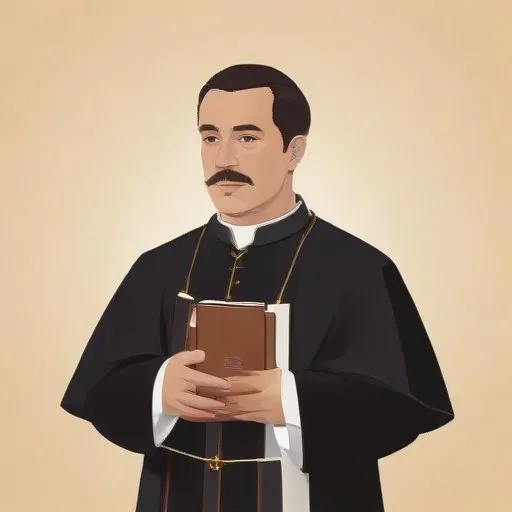
A Spanish priest and saint who led the Society of Jesus, reforming it and promoting missionary work, while also being known for his mysticism and spiritual writings.
Francis Borgia, 4th Duke of Gandía, is renowned for being the great-grandson of Pope Alexander VI and a prominent figure in the Society of Jesus, where he served as the third Superior General. He is also revered as a saint in the Catholic Church, recognized for his piety, humility, and tireless efforts to reform the Church.
Born on October 28, 1510, in Gandía, Valencia, Spain, Francis Borgia was the eldest son of Juan Borgia, 3rd Duke of Gandía, and Juana of Aragon. His family's aristocratic lineage was marked by scandals and controversies, but Francis would later redeem the family name through his virtuous life.
The turning point in Francis' life came in 1539, when he attended the funeral of Isabella of Portugal, the wife of Emperor Charles V. Witnessing the decay of her corpse, Francis was deeply moved and began to question the transience of human life. This experience sparked his spiritual awakening, leading him to renounce his titles and wealth to pursue a life of piety and service.
In 1546, Francis joined the Society of Jesus, founded by St. Ignatius of Loyola. He became a close friend and confidant of Ignatius, who saw great potential in Francis' leadership abilities. Francis would go on to play a crucial role in shaping the Jesuit Order, serving as the third Superior General from 1565 to 1572.
During his tenure as Superior General, Francis implemented various reforms, including the establishment of the Jesuit novitiate, the creation of a Ratio Studiorum (a standardized curriculum for Jesuit schools), and the expansion of Jesuit missions worldwide. He also played a key role in the Council of Trent, contributing to the Church's renewal and counter-reformation efforts.
Francis Borgia was canonized a saint in 1671, just 100 years after his death in 1572. His feast day, October 10, is celebrated by the Jesuit Order and the Archdiocese of Valencia. Through his remarkable life, Francis demonstrated that even those born into wealth and power can choose a path of humility and service, leaving a lasting impact on the Church and the world.
Today, Francis Borgia's legacy continues to inspire generations of Jesuits and Catholics worldwide, reminding us that true greatness lies not in wealth or power, but in serving others and living a life of virtue and devotion.
Born in 1491
Founded the Jesuit Order, a Catholic religious organization known for its missionary and educational work, and developed the Spiritual Exercises, a guide for spiritual growth and discernment.
Born in 1506
Co-founder of the Society of Jesus, a Catholic religious order, known for his missionary work in Asia, especially in India and Japan, and for his role in the Counter-Reformation. He's revered for his tireless efforts to spread Christianity and his compassion for the poor and marginalized.
Born in 1521
A 16th-century Jesuit priest and doctor of the church, he played a crucial role in counter-reformation efforts, and his writings helped shape Catholic theology.
Born in 1542
A 16th-century theologian and doctor of the Church, known for his writings on spirituality and his role in shaping Catholic doctrine. He was a key figure in the Counter-Reformation, defending Catholicism against Protestantism.
Born in 1568
This 16th-century Jesuit saint is revered for his selfless devotion to caring for plague victims, ultimately sacrificing his life to save others. He's a powerful symbol of compassion and charity.
Born in 1538
A 16th-century Italian reformer who played a key role in the Counter-Reformation, implementing significant reforms within the Catholic Church, and was known for his piety and charitable works.
Born in 1515
A 16th-century Spanish mystic and writer who introduced reforms to the Carmelite Order, promoting contemplative prayer and spiritual growth. Her writings are still widely read today.
