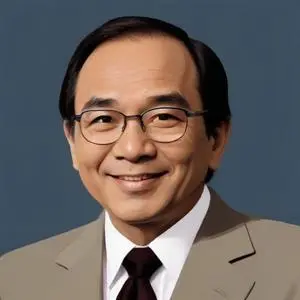
Francis Fukuyama: The Visionary Political Scientist and Author
A Prophet of Democracy and the End of History
Francis Fukuyama, a renowned American political scientist, political economist, and author, is best known for his groundbreaking book,
The End of History and the Last Man, published in 1992. This seminal work posits that liberal democracies and free-market capitalism may signal the end point of humanity's sociocultural evolution and political struggle, marking the final form of human government.
A Life of Academic Pursuits and Intellectual Curiosity
Born on October 27, 1952, in the Hyde Park neighborhood of Chicago, Fukuyama's intellectual journey began at Cornell University, where he earned his Bachelor's degree in Classics. He later pursued his Master's degree in Comparative Literature at Yale University and his Ph.D. in Political Science from Harvard University.
Academic and Professional Career
Fukuyama's distinguished academic career has taken him to various esteemed institutions, including the School of Advanced International Studies at
Johns Hopkins University, where he served as a professor and director of the International Development program. He has also held positions at
George Mason University, Stanford University, and the RAND Corporation. Currently, he is a senior fellow at the Freeman Spogli Institute for International Studies and the Mosbacher Director of the Center on Democracy, Development, and the Rule of Law at Stanford University.
Philosophical Contributions and Beliefs
Fukuyama's work often explores the intersection of politics, economics, and culture. In
Trust: The Social Virtues and Creation of Prosperity (1995), he refined his earlier argument, acknowledging that culture cannot be separated from economics. His writings have sparked significant debates and criticisms, reflecting his commitment to intellectual honesty and nuance.
Influence on Modern Society
Fukuyama's ideas have had a profound impact on modern political discourse. His concept of the "end of history" has influenced policymakers, scholars, and the general public, sparking discussions about the trajectory of human progress and the role of liberal democracies in shaping global politics.
Career Highlights and Major Works
- The End of History and the Last Man (1992)
- Trust: The Social Virtues and Creation of Prosperity (1995)
- Our Posthuman Future: Consequences of the Biotechnology Revolution (2002)
- The Origins of Political Order: From Prehuman Times to the French Revolution (2011)
- Political Order and Political Decay: From the Industrial Revolution to the Present Day (2014)
Awards and Honors
Fukuyama has received numerous accolades for his contributions to political science and academia, including the Riggs Award for Lifetime Achievement in International and Comparative Public Administration in 2024.
Personal Relationships and Anecdotes
Despite his intellectual stature, Fukuyama has distanced himself from the neoconservative movement, demonstrating his willingness to critically evaluate and adapt his ideas.
Impact on Pop Culture
Fukuyama's ideas have permeated popular culture, with references to his work appearing in films, literature, and media. His concept of the "end of history" has been explored in various artistic forms, reflecting his influence beyond the academic realm.
Historical Context and Legacy
As a leading figure in international relations and political science, Fukuyama's work continues to shape contemporary debates about democratization, globalization, and human progress. His legacy will undoubtedly influence future generations of scholars, policymakers, and thinkers.
Trivia and Fun Facts
- Fukuyama's surname is of Japanese origin, reflecting his father's heritage.
- He has been a council member of the International Forum for Democratic Studies and a member of the Political Science Department at the RAND Corporation.
- Fukuyama has been named one of the 25 leading figures on the Information and Democracy Commission launched by Reporters Without Borders.
Inspirational Stories and Motivations
Francis Fukuyama's remarkable academic journey, marked by intellectual curiosity and a commitment to critical thinking, serves as a powerful inspiration to scholars and individuals worldwide. His work continues to challenge and provoke, encouraging us to re-examine our assumptions about human progress and the role of liberal democracies in shaping our shared future.
FAQ
What is Francis Fukuyamas most famous book?
Francis Fukuyama, an American political scientist, economist, and author, is best known for his book The End of History and the Last Man, which argued that liberal democracy had triumphed as the dominant form of government.
What is Francis Fukuyamas take on the role of the state?
Francis Fukuyama believes that a strong, effective, and accountable state is essential for economic development, social order, and human well-being. He has argued that weak or failed states are often the root cause of many global problems.
Has Francis Fukuyama received any notable awards for his work?
Francis Fukuyama has received several awards for his work, including the National Humanities Medal, the Bradley Prize, and the Irving Kristol Award.
What is Francis Fukuyamas stance on globalization?
Francis Fukuyama believes that globalization has brought many benefits, such as increased economic growth and improved living standards, but also poses significant challenges, such as income inequality and cultural homogenization.