


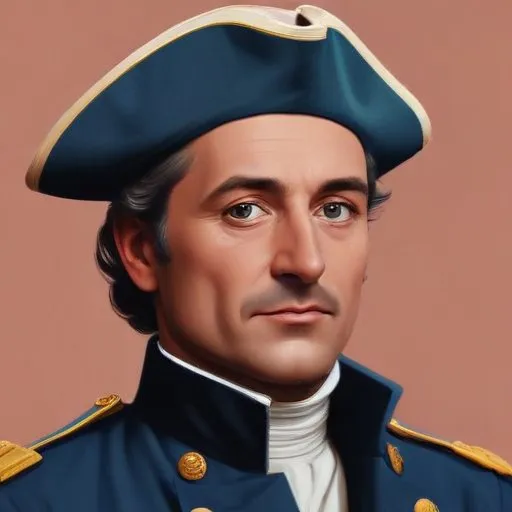
Led a daring expedition to navigate the Mekong River, exploring Southeast Asia and documenting its geography, cultures, and resources. His writings and maps helped shape European understanding of the region.
Francis Garnier, a French officer and explorer, is renowned for his trailblazing expeditions in 19th-century Southeast Asia, particularly in the Mekong River region. As the leader of the Mekong Exploration Commission, Garnier's journeys opened up new avenues for European exploration and trade in the region.
Born on July 25, 1839, in Saint-Etienne, France, Garnier hailed from a family that disapproved of a military career. However, at the age of 16, he defied his family's wishes and joined the Ecole Navale, the French naval academy. This decision would prove to be a defining moment in his life, as he would go on to make a name for himself in the annals of French naval history.
In the early 1860s, Garnier saw action in the Cochinchina Campaign, participating in the storming of the K Ha lines. His bravery during this campaign earned him a promotion to ensign and attachment to the staff of Admiral Charner. These formative experiences laid the foundation for his future expeditions in Southeast Asia.
In 1862, Garnier was appointed inspector of native affairs in Cochinchina, where he was entrusted with the administration of Cholon, a suburb of Saigon. During this period, he suggested to the Marquis de Chasseloup-Laubat that a mission be sent to explore the valley of the Mekong River. Although Garnier was not deemed old enough to lead the expedition, he played a crucial role in its planning and preparation.
The Mekong Exploration Commission, led by Captain Ernest Doudard de Lagrée, set out in 1866 to navigate the treacherous waters of the Mekong River. Garnier, who joined the expedition as second-in-command, proved instrumental in the success of the mission. Over the course of the expedition, the team traversed an astonishing 5,392 miles, of which 3,625 miles were previously uncharted territory.
Garnier's expeditions not only expanded European knowledge of Southeast Asia but also paved the way for future explorers and traders. His meticulous surveys and astronomical observations helped to create accurate maps of the region, thereby facilitating further exploration and colonization.
In recognition of his contributions, Garnier was awarded the Patrons Medal of the Royal Geographical Society of London in 1870. This prestigious honor cemented his reputation as a pioneering explorer and earn him a place in the pantheon of French heroes.
Today, Francis Garnier is remembered as a trailblazer who expanded European understanding of Southeast Asia. His expeditions not only opened up new avenues for trade and exploration but also left an indelible mark on the region's history.
As a testament to his enduring legacy, Garnier's name has been immortalized in various forms, including the naming of a river in Vietnam after him. His contributions to the fields of geography and exploration continue to inspire generations of scholars, adventurers, and enthusiasts alike.
Born in 1828
A visionary writer who pioneered the science fiction genre, crafting timeless tales of adventure and exploration that continue to inspire generations.
Born in 1852
Italian-French explorer who charted the Congo River and founded the French Congo, establishing French colonial rule in central Africa. He's also known for his humanitarian efforts to end slavery and promote African welfare.
Born in 1813
A Scottish missionary and explorer who traversed Africa, mapping its rivers and discovering Victoria Falls, while fighting against the slave trade. He embodied courage, compassion, and curiosity.
Born in 1868
Led a British expedition to the South Pole, racing against a Norwegian team, and tragically perished on the return journey. He is remembered for his bravery and sacrifice in the pursuit of scientific discovery.
Born in 1872
First person to reach the South Pole, leading a Norwegian expedition in 1911, and a pioneer in Arctic and Antarctic exploration.
Born in 1874
Led expeditions to the Antarctic, famously surviving a disastrous shipwreck and trekking to safety, earning a legendary reputation for bravery and leadership.
