


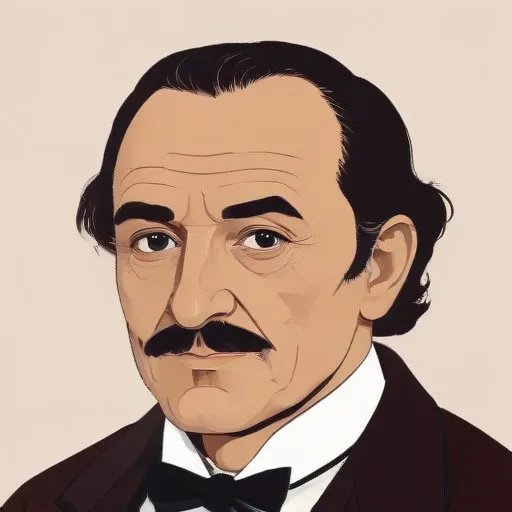
A 19th-century polymath who made significant contributions to chemistry, medicine, and politics, known for his pioneering work in cytology and the discovery of the axon.
Franois-Vincent Raspail, a French chemist, naturalist, physician, and politician, is renowned for his groundbreaking contributions to the cell theory in biology and his advocacy for the use of microscopes in plant studies. He is also credited with coining the phrase "omnis cellula e cellula" or "every cell is derived from a preexisting cell," which was later attributed to Rudolf Karl Virchow.
Born on January 25, 1794, in Carpentras, Vaucluse, Raspail was fascinated by the natural world from a young age. He pursued his passion for science and medicine, earning a degree in law and later in medicine.
Raspail's work in biology and chemistry paved the way for significant advancements in the field. He was an early proponent of the use of antiseptics and better sanitation and diet. His book, Manuel annuaire de la santé (1834), emphasized the importance of hygiene and preventative medicine. This influential work is famously depicted in Vincent van Gogh's painting, Still life with a plate of onions (1889).
Raspail's strong republican beliefs led him to join the Carbonari society and Freemasonry, where he rubbed shoulders with prominent figures like Franois Arago, Victor Schoelcher, and Auguste Blanqui. His involvement in the attempted revolt of May 15, 1848, and his candidacy for the presidency of the Second Republic in December 1848 led to his imprisonment. After Louis Napoleon's coup in 1851, Raspail was exiled, only returning to France in 1862. He continued to be a vocal advocate for the republic, serving as a deputy from Lyons in 1869.
Raspail's family was a hub of intellectual and political activity. His sons, Benjamin, Camille, mile, and Xavier, all made significant contributions to the Third Republic. His daughter, Marie, was a staunch supporter of her father and a freethinker, succumbing to illness contracted while caring for him during his imprisonment.
Raspail's pioneering work in cell theory, his advocacy for hygiene and sanitation, and his unwavering commitment to the republican cause have left an indelible mark on French history. His legacy continues to inspire generations of scientists, politicians, and thinkers.
Raspail's remarkable life, marked by scientific innovation, political passion, and personal sacrifice, serves as a testament to the power of human curiosity and conviction.
Born in 1743
Father of modern chemistry, discovered oxygen, and developed a systematic method of chemical nomenclature. He laid the foundation for modern chemistry and paved the way for future scientific discoveries.
Born in 1749
Developed nebular hypothesis of the origin of the solar system and formulated Laplace's equation, a fundamental concept in mathematics and physics. He's considered the founder of celestial mechanics.
Born in 1744
A French soldier, biologist, and academic who developed a theory of inheritance of acquired characteristics, proposing that organisms adapt to their environment and pass on those traits to their offspring.
Born in 1769
Founded the field of comparative anatomy, establishing extinction as a fact and creating a framework for understanding the natural world through fossil records.
Born in 1775
A pioneer in the field of electromagnetism, he formulated fundamental laws that describe the relationship between electric currents and magnetic fields. His work laid the foundation for many modern technologies, including electric motors and generators.
Born in 1786
A mathematician and politician who made significant contributions to the development of electromagnetism and served as Prime Minister of France, advocating for social reform and education.
Born in 1822
Developed vaccines for rabies and anthrax, and pioneered the germ theory of disease, revolutionizing our understanding of microbiology and disease prevention.
Born in 1813
Pioneering physiologist who introduced the concept of homeostasis, revolutionizing our understanding of the human body's internal balance and its response to environmental changes.
