


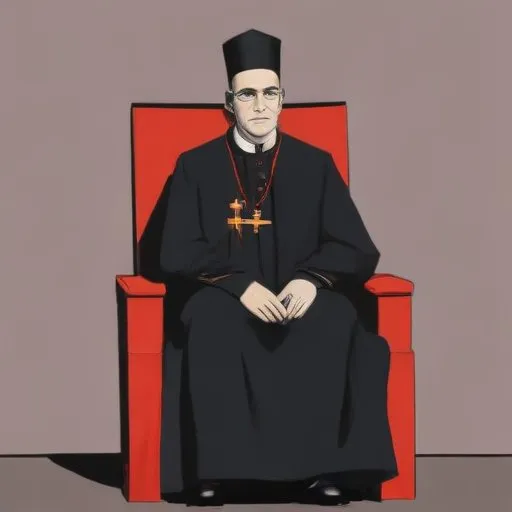
A Jesuit priest who served as the confessor to King Louis XIV of France, influencing the monarch's decisions and shaping the country's politics. He was a powerful figure in the French court, known for his piety and diplomatic skills.
Franois de la Chaise, a French Jesuit priest, is best known for his role as the father confessor of King Louis XIV of France. Throughout his career, he wielded significant influence over the monarch, shaping his decisions and policies, particularly in matters of faith and state.
Born on August 25, 1624, at the Château of Aix in Aix-la-Fayette, Puy-de-Dôme, Auvergne, Franois de la Chaise was the son of Georges d'Aix, seigneur de La Chaise, and Renée de Rochefort. His maternal lineage connected him to Pierre Coton, the confessor of Henry IV.
De la Chaise became a novice of the Society of Jesus before completing his studies at Lyon, where he lectured on philosophy to students drawn from all parts of France. His reputation as a learned and sagacious theologian spread far and wide, earning him the attention of powerful figures in the French court.
In 1674, Camille de Villeroy, Archbishop of Lyon, nominated de la Chaise as the confessor of King Louis XIV, thereby entrusting him with the administration of the ecclesiastical patronage of the crown. This position granted de la Chaise immense influence over the monarch and his policies, allowing him to shape the king's decisions on matters of faith and state.
De la Chaise's influence was further amplified by his close alliance with Madame de Maintenon, the king's mistress and future wife. Together, they convinced Louis XIV to abandon his illicit relationship with Madame de Montespan, solidifying de la Chaise's position as a trusted advisor.
De la Chaise played a pivotal role in the revocation of the Edict of Nantes, which had granted religious freedom to French Protestants. This decision led to widespread persecution and flight of Huguenots from France, earning de la Chaise criticism from many quarters.
In his capacity as confessor, de la Chaise often clashed with the king over matters of conscience, including the king's reluctance to abandon his mistress, Madame de Montespan. He also mediated between Louis XIV and Innocent XI, the Pope, during the Gallican Church's temporalities dispute, advocating for the royal prerogative while attempting to conciliate the papal authorities.
Franois de la Chaise died on January 20, 1709, leaving behind a complex and multifaceted legacy. While he was criticized for his role in the persecution of Huguenots and his perceived meddling in politics, he remains an important figure in French history, exemplifying the intricate dance between faith, power, and politics during the reign of Louis XIV.
Today, de la Chaise's influence extends beyond his role as confessor, symbolizing the enduring tension between spiritual guidance and statecraft. His life serves as a testament to the intricate web of relationships between faith, morality, and politics that continue to shape our world.
Born in 1627
A 17th-century French bishop and theologian who wrote influential works on theology, politics, and history, shaping the Catholic Church's stance on various issues. He's also known for his eloquent sermons and funeral orations.
Born in 1651
A 17th-century French archbishop and poet who wrote influential works on spirituality and morality, including the famous novel "Telemachus".
Born in 1663
A 17th-century French bishop who preached eloquent sermons that emphasized the importance of moral living and was known for his powerful oratory skills, influencing many with his words.
Born in 1632
A renowned 17th-century French Jesuit preacher and academic, celebrated for his eloquent sermons and influential writings on theology and moral philosophy. He was a prominent figure in the French Counter-Reformation, shaping Catholic thought and spirituality.
Born in 1632
A 17th-century French bishop and author, known for his eloquent sermons and influential writings that shaped the literary and religious landscape of his time.
Born in 1581
A 17th-century French priest dedicated his life to serving the poor and marginalized, establishing a congregation of priests and nuns to provide aid and comfort to those in need. He's revered for his selfless charity and compassion.
Born in 1575
Founded the French school of spirituality, he's a prominent figure in Catholic theology, known for his mystical and devotional writings that emphasized the importance of spiritual direction and the interior life.
