


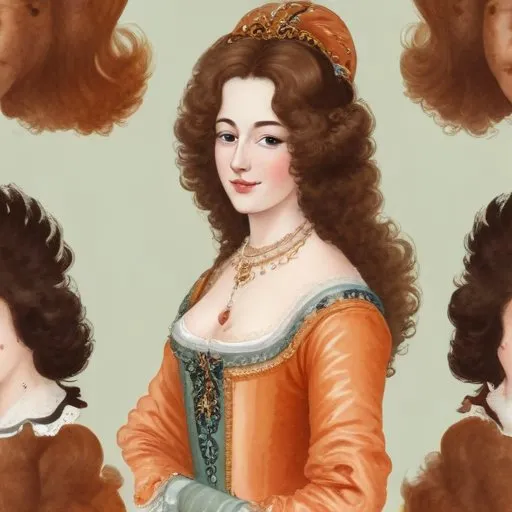
The mistress of the Sun King, known for her beauty, wit, and influence over the French monarch, shaping the course of royal politics and art patronage.
Franoise Athenais, Marquise de Montespan, was a French aristocrat and courtesan who became the mistress of King Louis XIV, earning the nickname "La Montespan." Her tumultuous relationship with the King and her involvement in the infamous Affair of the Poisons made her one of the most notorious women of 17th-century France.
Born on October 5, 1640, in Lussac-les-Châteaux, France, Athenais was a member of the Athenais family, a noble household. She received an excellent education, which instilled in her a love for literature and the arts. Her intelligence, beauty, and charm caught the attention of King Louis XIV, who was seeking a new mistress to replace his current favorite, Louise de La Vallière.
Athenais's affair with King Louis XIV began in 1667 and lasted for over 12 years. During this period, she wielded significant influence over the monarch, earning her the envy and resentment of the royal court. Her lavish spending and extravagant lifestyle led to rumors of embezzlement and corruption, further tarnishing her reputation.
In 1679, Athenais became embroiled in the infamous Affair of the Poisons, a scandal involving a series of mysterious deaths and alleged poisonings. Athenais was accused of using black magic and poison to retain the King's favor and eliminate her rivals. Although she was eventually cleared of any wrongdoing, the scandal irreparably damaged her reputation.
Athenais's life was marked by scandal, controversy, and tragedy, yet her story has captivated historians and novelists alike. Her involvement in the Affair of the Poisons has been immortalized in literature, art, and film, ensuring her place in the annals of French history.
Athenais's rise to prominence and fall from grace can be compared to that of her contemporaries, such as Madame de Maintenon, who eventually replaced her as the King's mistress. While both women shared a desire for power and influence, their approaches and moral compasses differed significantly.
Athenais's story serves as a cautionary tale about the transience of power and the dangers of unchecked ambition. Her life also highlights the limited options available to women in 17th-century France, forcing them to rely on their wit, charm, and beauty to achieve success.
Athenais spent the remainder of her life in a convent, where she dedicated herself to prayer and penance. She died on May 27, 1707, at the age of 66, her tumultuous life a testament to the complexities and contradictions of human nature.
Born in 1710
The monarch who ruled France from 1715 to 1774, known as the "Sun King's" great-grandson, and remembered for his extravagance, absolutism, and the decline of the French monarchy.
Born in 1640
Younger brother of King Louis XIV, known for his military prowess and cultural patronage, particularly in the arts.
Born in 1639
A 17th-century master of French tragedy, crafting intricate, psychologically complex dramas that probed the human condition, influencing the development of Western theatre.
Born in 1622
A 17th-century master of comedy, he penned witty plays that satirized the French aristocracy, leaving a lasting impact on Western theater. His works remain widely performed and adapted today.
Born in 1621
A 17th-century master of fables, crafting witty, moral tales that entertain and educate, still widely read and adapted today.
