


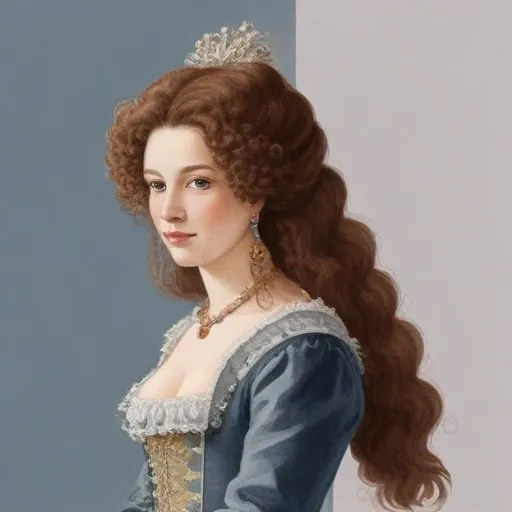
The secret wife of the Sun King, who rose from humble beginnings to become a powerful queen, known for her influence on French politics and education, and her role in shaping the royal court.
Franoise d'Aubign, known to history as Madame de Maintenon, was the secret wife of Louis XIV of France, wielding profound influence over the monarch and the French court from 1683 until his death in 1715. As the most powerful woman in France, she played a crucial role in shaping the king's policies,religious outlook, and even the education of young noblewomen.
Born on November 27, 1635, in Niort, France, Franoise was the daughter of a Huguenot noble family. Her early life was marked by poverty, but her fate changed when she married the poet Paul Scarron in 1652. This union offered her access to the Parisian high society, where she mingled with the elite and cultivated connections that would serve her well in the future.
Widowed in 1660, Madame Scarron (as she was then known) found favor with Louis XIV's mistress, Madame de Montespan, who entrusted her with the care of the king's illegitimate children. When the children were legitimized, Madame Scarron was appointed royal governess, and in 1675, Louis XIV granted her the title Marquise de Maintenon.
After the death of Queen Maria Theresa in 1683, Madame de Maintenon secretly married Louis XIV, solidifying her position as the most influential woman in France. She became the king's closest adviser, shaping his policies and exerting a profound impact on his religious beliefs. Her piety had a profound effect on the king, who became more devoted to his Catholic faith and abandoned his mistresses.
In 1686, Madame de Maintenon founded the Maison royale de Saint-Louis, a pioneering institution for the education of young noblewomen from impoverished families. This school had a lasting impact on female education under the Ancien Régime, producing women who went on to shape French society.
After Louis XIV's death in 1715, Madame de Maintenon retired to Saint-Cyr, where she lived out the remainder of her life. She died on April 15, 1719, at the age of 83, leaving behind a legacy as one of the most enigmatic and powerful women of the 17th century.
Throughout her life, Madame de Maintenon was the subject of controversy and intrigue. Her rise to power, her secret marriage, and her influence over the king raised eyebrows and sparked rivalries at court. Despite this, she remained a steadfast and devoted partner to Louis XIV, earning the respect and admiration of many.
Madame de Maintenon's legacy extends far beyond the confines of the 17th century. Her pioneering work in education and her commitment to philanthropy have inspired generations of women and continue to shape French society today.
Madame de Maintenon's remarkable life serves as a testament to the power and influence of women in history. Her enigmatic presence continues to captivate us today, inviting us to delve deeper into the mysteries and intrigue of 17th-century France.
Born in 1710
The monarch who ruled France from 1715 to 1774, known as the "Sun King's" great-grandson, and remembered for his extravagance, absolutism, and the decline of the French monarchy.
Born in 1674
The Regent of France from 1715 to 1723, known for his cultural and artistic patronage, and his role in shaping the country's politics during a period of significant change.
Born in 1641
A mastermind behind French military victories and reforms, credited with modernizing the French army and establishing the Palace of Versailles as a royal residence.
Born in 1619
A 17th-century mastermind who centralized France's economy, creating a powerful and efficient financial system that fueled the country's growth and prosperity. He's renowned for his innovative economic policies and reforms.
Born in 1638
The last Habsburg queen of Spain, she ruled from 1746 to 1765, and is known for her reforms and cultural achievements, including establishing the Royal Academy of Fine Arts.
Born in 1674
The Regent of France from 1715 to 1723, known for his cultural and artistic patronage, and his role in shaping the country's politics during a period of significant change.
