


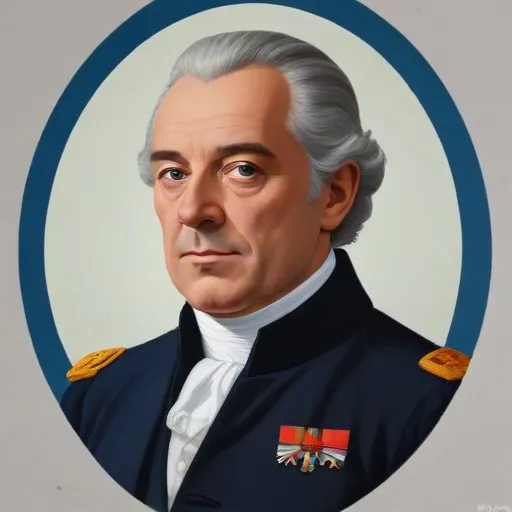
A mastermind behind French military victories and reforms, credited with modernizing the French army and establishing the Palace of Versailles as a royal residence.
As the French Secretary of State for War, Franois Michel le Tellier, Marquis de Louvois, played a pivotal role in transforming the French Army into a formidable force, earning him recognition as one of the most influential military strategists of the 17th century. Under his leadership, the French Army expanded to an unprecedented 340,000 soldiers, fighting four wars between 1667 and 1713, and cementing Louvois' legacy as a mastermind of modern warfare.
Born in Paris on January 18, 1641, to Michel Le Tellier and Élisabeth Turpin, Louvois was groomed for greatness from a young age. His father, a prominent statesman, instructed him in the intricacies of state affairs, which would later prove invaluable in his own rise to power. Louvois' talents were first noticed by the renowned Marshal Turenne during the War of Devolution (1667-1668), who mentored him in the art of supplying armies. This experience laid the foundation for his future success.
Louvois' most significant contributions to modern warfare were his sweeping reforms and innovations, which transformed the French Army into a highly efficient and effective force. He created the Régiment du Roi in 1663 and founded the Royal Artillerie regiment in 1673, setting a new standard for military organization and firepower. His introduction of portable ovens to bake bread during halt days and upgrade of the magazine system left by his father enabled armies to move swiftly and efficiently, providing a significant logistical advantage.
Louvois' remarkable logistical prowess allowed him to accumulate enough grain and wagons to provide his armies with 200,000 rations per day for up to six months during the Dutch War (1672-1678). This strategic planning enabled the French king to secure early victories and solidified Louvois' position as a trusted advisor. His influence extended beyond the battlefield, as he played a crucial role in shaping Louis XIV's foreign policy and military strategy.
Despite his many accomplishments, Louvois was not immune to criticism. His strict control over officers resulted in slower tactical and operational response times, which sometimes hindered the French Army's ability to adapt to changing circumstances. Additionally, his relentless pursuit of power and wealth led some to view him as ruthless and power-hungry.
Franois Michel le Tellier, Marquis de Louvois, left an indelible mark on the history of warfare. His creation of the role of civilian minister of war, a position that would become a cornerstone of modern military organization, is a testament to his visionary leadership. Despite his flaws, Louvois' innovative reforms, logistical genius, and strategic prowess have earned him a lasting reputation as one of the most influential military minds of the 17th century.
"The art of war is not just about winning battles, but about sustaining armies in the field."
"A well-fed army is a happy army, and a happy army is a victorious army."
"The key to military success lies not in the bravery of soldiers, but in the genius of logistics."
Franois Michel le Tellier, Marquis de Louvois, lived during a time of great upheaval and transformation in Europe. His military reforms and innovations occurred against the backdrop of the Thirty Years' War, the War of the Spanish Succession, and the rise of European powers such as France, England, and the Dutch Republic. Louvois' legacy extends beyond the military realm, as his organizational and logistical genius have inspired generations of military strategists, politicians, and leaders.
Born in 1710
The monarch who ruled France from 1715 to 1774, known as the "Sun King's" great-grandson, and remembered for his extravagance, absolutism, and the decline of the French monarchy.
Born in 1619
A 17th-century mastermind who centralized France's economy, creating a powerful and efficient financial system that fueled the country's growth and prosperity. He's renowned for his innovative economic policies and reforms.
Born in 1585
A powerful and cunning statesman who dominated French politics during the 17th century, known for his ruthless suppression of dissent and centralization of power. He was a master strategist and diplomat who shaped the course of European history.
Born in 1694
A witty and insightful 18th-century writer and philosopher who used satire to critique societal norms and advocate for reason, tolerance, and human rights.
Born in 1721
The influential royal mistress who dominated the French court with her beauty, wit, and politics, shaping the country's art, fashion, and culture. She was a patron of the arts and a trendsetter in 18th-century Europe.
Born in 1916
A French lawyer and politician who served as the 21st President of France, known for his socialist policies and role in shaping the European Union. He's also remembered for his controversial past and complex personality.
